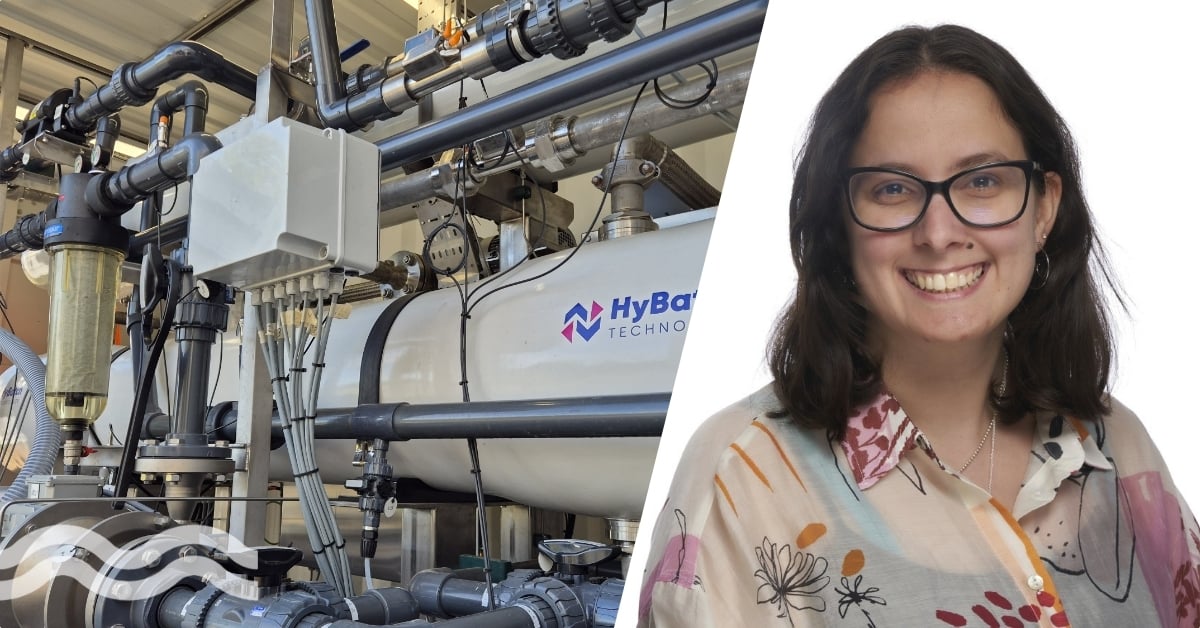
Raising a glass to water reuse across Portugal with Nuno Brôco
Portugal is leading the way in the technological innovation and practical application of water reuse. One man who has great experience in this area is Nuno Brôco, the executive president of AdP VALOR, the strategic engineering, circular economy and innovation arm of the Águas de Portugal utility group.
He talks to Tom Freyberg about circular economy challenges, including real-world examples of reuse and the challenge of navigating bottlenecks to innovation.
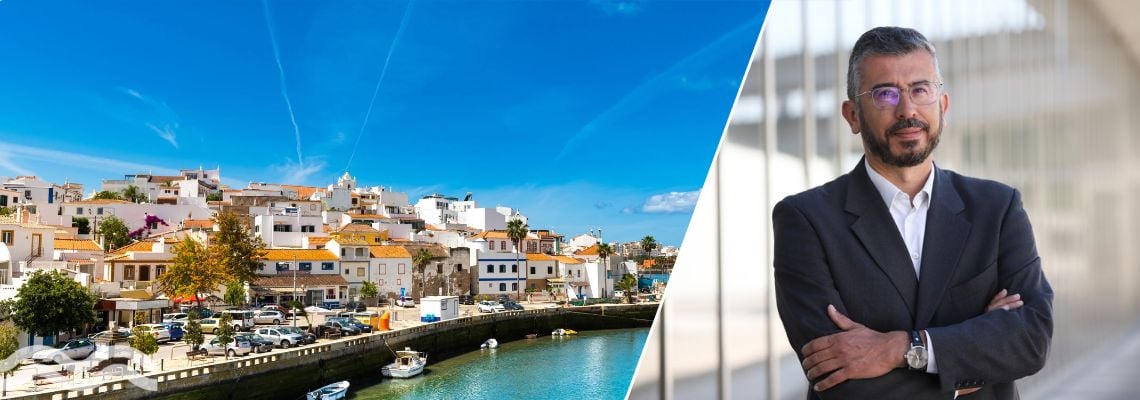
Navigating three bottlenecks to reuse
It’s not often you can speak to a utility boss about beer as part of a formal interview (more on that later). Yet, by the end of the interview with Nuno Brôco, I felt like I wanted to share a cold one with him to continue chatting about all things water reuse, innovation, the Algarve and the Portuguese water sector.
Brôco is a seasoned operator within the Águas de Portugal utility, which serves 235 municipalities and around eight million people. He previously sat on the board that converted the group’s former shared services company into AdP VALOR in 2021. After three years, he left to run Águas do Tejo Atlântico, and returned this year at what he describes as an ‘important moment of reorganisation’.
The rationale for AdP VALOR’s existence is simple – to separate the innovation arm of the business from the day-to-day firefighting that comes with operating a utility. The group's operating companies are consumed by daily delivery: water and wastewater service supply, serving municipalities and communities, and ensuring regulatory demands are met.
“The daily operations sometimes don't allow us to stop and think and to work on more strategic issues,” Brôco says.
AdP VALOR was created and separated out to focus on three pillars: circular economy with a heavy focus on sludge, innovation, and long-term strategic planning. The beauty of such a model lies in capturing what can fall between the cracks of individual companies working in a group, rather than a connected family of businesses.
“We act as a kind of glue between the different companies,” he says.
In practice, that means identifying internal champions across the operating companies and exporting their expertise. Listing examples, Brôco says utility Águas do Tejo Atlântico leads on reuse, whereas Águas do Algarve now leads on desalination with a plant in development.
Furthermore, an internal innovation fund awards €1 million a year by competition, financing winning projects in full. It is now in its fourth round, with results emerging from the first cohort.
When asked about potential bureaucracy of innovation being sped up by linking together multiple companies, Brôco gives an honest answer, suggesting there is still room for improvement. “The water sector is not so innovative, and we are very slow,” adding that: “We are still not happy, but we are on the way.”
The Algarve desalination box

Portugal has become a much-loved and regular family holiday destination for many. According to UN Tourism, the country welcomes around 5.3 million tourists every year, with many flocking to the Algarve region in the south. Like any popular tourist destination, this visitor influx has an impact on local infrastructure and services, namely water and wastewater.
To build resilience against the impacts of climate change and increasing demands from tourism, Portugal’s first large-scale seawater desalination plant is under construction at Albufeira. Although “scarcity in the Algarve was visible for years,” it took “two years of drought to trigger the decision to build,” adds Brôco.
As a result, he says one lesson for other European nations is that this pace is still too slow.
“Desalination plants of that kind cannot be delivered in a single year, so any delays can compound. What southern Europe lacks is permanent resilience planning with clear triggers for investment, rather than treating scarcity as an emergency only when reservoirs run low.”
Brôco also sees the wider picture – a 43,800 m3/day desalination plant is one tool in the toolbox for water resilience, not the entire toolbox. He says that the Algarve is an excellent “sandbox”, as desalination is being used alongside other measures: non-revenue water is being targeted to be cut across distribution networks with municipalities.
Furthermore, a reuse programme is underway to serve the region’s golf courses. Groundwater and surface water are being balanced, storage reinforced, systems interconnected, and the transboundary agreement with Spain revisited. Desalination, while it will be the most expensive water source in the region, is needed but is being seen as one source among many.
Sludge, glorious (or not) sludge
Brôco has strong views on sludge, especially when it comes to the economics. Some sobering numbers for context: until 2015, sludge disposal cost between €15 and €20 a tonne. Today, in some cases, the group pays close to €200 per tonne. Company-wide, that’s €40 million a year and the group’s second-highest cost after energy.
He attributes the rise partly to tighter regulatory enforcement, which he treats as legitimate, and partly to a market he calls “very short”. There are only five or six operators nationally, some of them struggling with the capacity to serve the group.
In 2020, the group decided to stop buying its way out, with the resulting strategy having two pillars. The operating companies are investing more than €100 million across 21 facilities, improving anaerobic digestion with hydrolysis, drying and composting to cut volume and lift quality. In addition, it also improves renewable energy production.
AdP VALOR will become the Group’s single nationwide operator, managing what comes out of those facilities, owning the business model, as well as the route to farmers and a voluntary certification scheme covering quality and traceability. The intent is to move sludge “from a disposal logic to a product logic”.
One of the drivers behind this move is soil protection. Southern Portugal is facing desertification, and organic matter is one of the few available levers, improving structure, fertility and the capacity of soil to hold water. The sources are limited to livestock manure, the organic fraction of urban waste, and wastewater sludge. Poor management by contractors in the past, Brôco says, has meant wasting some of that material, as well as the opportunity to improve soil health.
While talking about waste-to-resource and value, he discusses the ability to recover phosphorus from waste and its dependence on foreign markets. “In terms of phosphorus, we are totally dependent on sources from outside Europe,” he says. This is a problem common to many southern European countries, which are becoming more prone to desertification, making it harder to produce food within their own territories.
PFAS and the forever challenge
The link between water utilities and the agricultural sector needs to have farmers on board, and the topics of PFAS and microplastics have made that harder. A market study some years ago found farmers entirely clear about their need for organic matter, and equally clear about their fear of emerging pollutants.
Brôco's answer is to openly address this. “We should not put that under the carpet. We should bring the problem to the discussion,” he says.
AdP is monitoring, working with academia and laboratories, and building a voluntary certification system with farmers rather than presenting it to them, learning which substances concern them most. Portuguese law on the agricultural use of sludge is, he notes, already among the most demanding in Europe. He remains optimistic about his counterparts: “We have a very interesting generation of new farmers that are very keen for this.”
Commenting on where regulation is heading, he co-authored a Water Europe position paper arguing for control at source. Those substances reach sludge, he argues, because citizens use them daily, whereas utilities did not manufacture the problem.
Water reuse in action
During his time at Águas do Tejo Atlântico, which leads on reuse, the utility brewed a beer called VIRA, using recycled water from one of its Fábricas de Água, or water factories. VIRA, in Portuguese, means ‘turn’, or to “turn it around”, Brôco adds.
The translation of ‘turn’ can be interpreted a few ways here – to help turn around perceptions of water reuse, or to turn wastewater into a valuable product. In fact, changing perceptions was the exact intention, with the beer launched in 2019 but never sold. It was developed as a communication tool, directed at the country's environmental regulator, and it worked better than intended.
Now, at every Tejo Atlântico social event, Brôco recalls, “people are aware and are always asking, ‘Where is the beer? How can we taste the beer?’ We don't sell it; we only offer it to our guests, but it’s a success.”
Portugal is not alone in this idea. In Singapore, the water agency PUB has NEWBrew, and San Francisco start-up Epic Cleantech has seen success with its OneWater Brew.
One problem the sector has not solved
A final topic we talk about is perhaps one of the most important, and one that keeps most utility bosses up at night, beyond terrible indigestion. That is, the talent war and how water is on the back foot.
Brôco has benefitted from a rewarding career within the group, moving between divisions, helping to establish new ones and navigating between the strategic direction of a water company and the tactical execution. Yet, he believes there remains a lack of opportunities in the Portuguese water sector. He believes recruiting young people to the sector isn’t improving. In fact, it’s getting harder.
He puts this down to three reasons. First, public sector pay frameworks leave utilities uncompetitive against other markets such as IT and energy. Second, school leavers have no idea what a career in water involves. Third, young students are drawn to complex problems, he says, and the sector has failed to explain that it has any.
“We are not able to explain and communicate the huge challenge that we have in our sector,” he adds.
Ironically, the link between communicating about purposeful careers in water comes back full circle to beer as a communication tool. A water utility that brews its own beer, to prove recycled water is safe, has figured out that you cannot solely communicate and attract younger generations to topics like water reuse by talking about membrane specs; you need to think broader.
Clearly, there is work left to do for Brôco in AdP VALOR and the broader Águas de Portugal group. Yet the innovative structure that led to AdP VALOR’s creation, the innovation fund, and many other elements are ones that can be shared with utilities across Europe as steps in the right direction. I’ll certainly raise a glass of VIRA to that.
The article is part of a strategic partnership between Aquatech Global Events and the Leading Utilities of the World (LUOW). Previous articles include:
Why Paul Sciuto bet Monterey One Water’s name on reuse
From engineering to executive – How Kishia L Powell is transforming WSSC Water
Breaking water siloes in California and beyond – Joone Kim-Lopez
Share your water technology stories with us
Do you have an innovation, research results or an other interesting topic you would like to share with the international water technology industry? The Aquatech website and social media channels are a great platform to showcase your stories!
Please contact our Sr Brand Marketing Manager Annelie Koomen.
Are you an Aquatech exhibitor?
Make sure you add your latest press releases to your Company Profile in the Exhibitor Portal for free exposure.