Breaking water siloes in California and beyond - Joone Kim-Lopez
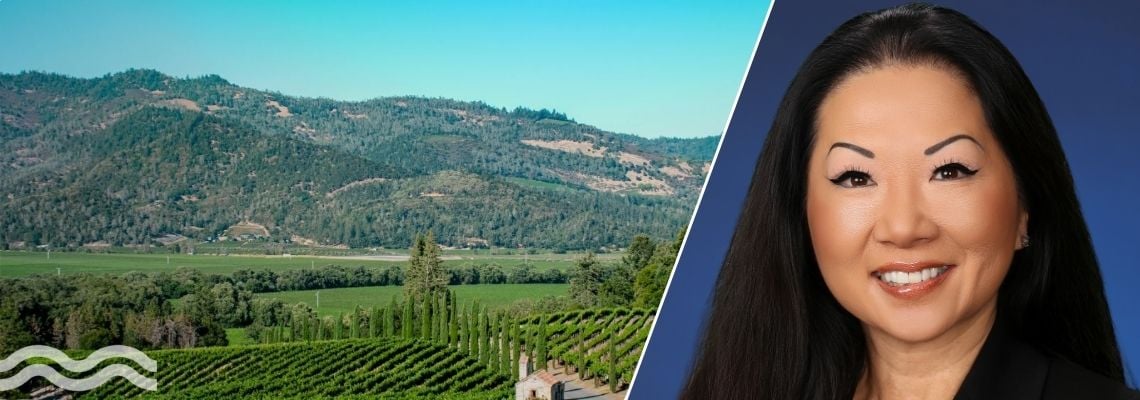
“The ‘silver tsunami’ can’t happen fast enough,” states Joone Kim-Lopez, general manager and CEO of the Moulton Niguel Water District (MNWD).
This isn’t the kind of statement you expect to hear from a well-established water utility CEO, yet Kim-Lopez doesn’t come across as your conventional water leader. She doesn’t shy away from challenging the status quo. Her comments on the silver tsunami come amidst increasing concern that a large proportion of highly skilled, seasoned water engineers are nearing the end of their careers and on the verge of retirement. Without attracting and recruiting young, skilled engineers to match the potential drop off, water utilities are putting themselves at risk from a widening skills gap.
Rather than agree with the concern, this CEO challenges the assumption. She believes it’s not about pushing experience out the door, but about mindset and building a culture that’s ready for strategic transformation.
Located in southern California, the utility provides drinking water and wastewater services across six cities in South Orange County, serving a population of approximately 172,000 people.
Stagnation as a risk
For Kim-Lopez, generational diversity is the key to fuelling progress.
“The reason that I say the silver tsunami can't happen fast enough is not because I want people to leave, but it's a mindset of creating that succession,” she says. “It is to say that nothing stays the same. Change is not only inevitable, but change is powerful and necessary.”
Kim-Lopez speaks with the refreshing confidence and vision of a start-up founder on a mission to make a dent in the universe, rather than a conservative utility CEO. She talks openly about the change that is needed. And stagnation, she argues, is the real risk.
“If you're not growing, you're dying,” Kim-Lopez exclaims, before referencing the need for technology and AI to help build the bridge between generations. “There is a huge amount of asset and infrastructure knowledge that resides in people’s heads, but now technology can help to assist that transition and that teaching to the next generation.”
Yet scale and structure are one part of the story. Kim-Lopez repeatedly returns to relationships as the foundation of utility resilience.
“We have a very unique close relationship with our city officials, with our customers, with civic leaders, and all the stakeholders that really are critical to the success of our operation,” she says. “We pride ourselves on that trust-based relationship, which is everything. Even though we're in a very technical industry, without people, trust, and the relationship, nothing works.”

‘Resilient together’, and a data movement
One of the themes of MNWD is ‘resilient together’.
“Whether it's water reliability in terms of supply or the system, we all need the perspectives and the ideas. It’s the actions of everyone to make sure that the policies and initiatives that allow our communities to thrive are successful.”
For MNWD, digital transformation was born out of necessity, rather than following buzzwords or trends.
“Our work in innovation and particularly related to data started in 2015,” Kim-Lopez recalls. “California experienced the historic drought, and we realised as an industry, we didn't have the kinds of data that we needed to develop policies, and make decisions that have the right outcome.”
Data siloing and fragmentation are often cited as common problems, as is the need for clean, standardised and centralised data. At MNWD, this was to be the catalyst for change, a process that began with Kim-Lopez bringing together like-minded utility CEOs in the region.
We realised as an industry, we didn't have the kinds of data that we needed to develop policies
As well as five utility CEOs, she contacted data scientists at New York University. That initial contact and unification of multiple water companies was the grassroots genesis for the California Data Collaborative. This was initially designed to enable “data-informed policies and decisions for a resilient water future”.
Reflecting on founding this collaborative, Kim-Lopez focuses on the power of storytelling.
“We were able to tell our stories and our experience with data, and we were able to also make decisions that were informed,” she says. “And we were able to be more transparent and accountable to everyone, the public, our customers, and decision makers about why the actions that we were taking were working.”
Growing the California Data Collaborative
Ten years later, the collaborative has grown significantly, representing 21 million Californians who are served by 37 utilities. Other major agencies that have signed up include the Los Angeles Department of Water and Power, Metropolitan Water District of Southern California, and San Diego County Water Authority, among others.
While focused on California, the ambition is open-ended. “We welcome anyone to be part of the collaborative,” Kim-Lopez says. “But really, the goal is to expand the membership and the community. And it is a very inclusive environment that we created.”
The scope of the California Data Collaborative has also widened beyond demand management into asset management. It is also looking at how different infrastructure, such as energy, transportation, telecommunication, and public safety, can be better integrated with data, “so that we could plan and respond better in an emergency, and recover faster”.

Building a BLUE ecosystem
Following its data collaboration with external utilities, MNWD is addressing deeper digital integration within its own organisation through its BLUE initiative (Building a Leading Utility Ecosystem). This is described as a “utility-wide program that leverages advanced analytics, artificial intelligence, and unified data governance to optimise water and energy systems in near-real time”.
Kim-Lopez says that one of the problems with water agencies is the multiple data sets, housed on separate platforms, without a common language. By integrating these systems, MNWD aims to shift from reactive to predictive asset management.
If we can be predictive, then we can be very targeted with our investment
“If all of this different information and data are integrated, then we can troubleshoot problems before they happen,” she explains. “If we see anomalies, that means there likely is a leak, or there will be a leak, and being able to be predictive in asset management rather than reactive, it really will be something that would benefit our customers.”
The CEO adds that another benefit would be more targeted capital investment. “If we can be predictive, then we can be very targeted with our investment,” she adds.
Denmark and integrated resilience
Internationally, MNWD maintains a memorandum of understanding with the Danish government and Aarhus Vand.
“When I met the officials from Denmark, it was fascinating,” Kim-Lopez says. “They have very similar challenges. And they have managed to be both sustainable and resilient.”
The knowledge exchange flows both ways, with Aarhus Vand learning from MNWD in terms of the work that’s been done with customers and setting rates, and the other way around in terms of leak detection and how to be more efficient in water use.
They have very similar challenges. And they have managed to be both sustainable and resilient
One element particularly excites the CEO. “They operate in an integrated space, so they can see everyone's infrastructure,” she explains, referring to Denmark’s cross-sector mapping of lifeline assets. Bringing this back home, she adds: “It's really about keeping our communities safe and resilient because disasters will happen. It's not a matter of if, it's when… this kind of premeditated, proactive, integrated planning saves lives.”
Turning to solar energy to mitigate rising energy costs
Energy remains one of the highest operating costs for water utilities. MNWD has invested in solar and microgeneration projects to help mitigate rising prices. One solar development has enabled the utility to power its own headquarters, with a three-year return on investment.
The district is working with San Diego Gas & Electric to leverage grid credits for its facilities. One motivation is financial stewardship.
“If we can power our entire headquarters with solar, then it’s a big help financially. Doing these types of projects is a way to let our customers know that we are seeking every opportunity to optimise our service,” adds the CEO.
A refreshing perspective
For a public utility CEO, Kim-Lopez has a bold, strong viewpoint that runs the risk of being divisive. Yet, it’s refreshing to hear. Perhaps, in a world of climate uncertainty, digital disruption and hype, and creaking infrastructure, it’s the type of mindset that will lead a utility through strategic transformation and attract the new talent needed to do so.
Kim-Lopez believes water is in a transition period. Across areas such as energy, digitalisation, international collaboration, and strategic transformation, it’s clear that change under her leadership is underway. MNWD will be one utility to watch to see how other developments are taking shape.