Water reuse: The choose-your-own-adventure resilience playbook
By Veronika Zhiteneva
Recently, we’re hearing more often that “no one talks about” this or that, or “how game-changing” something is. But the reality has stayed the same, despite how AI-generated content and phrasing may make it seem. There are rarely true silver bullets when it comes to decisions in real life, particularly under uncertain conditions.
This is particularly true for water utilities. The timescale on which decisions are evaluated, prepared, and executed is not friendly to disruptive innovation. That is what makes discussing resilience options today even more important. One such option is water reuse.
Reuse increases your options
What I find most interesting about water reuse is that it’s like a choose-your-own-adventure book, with multiple different scales and options for tailoring a solution to local conditions.
Using water quality that is fit-for-purpose is the goal. Paying too much for potable water for your enterprise, or looking to expand but not getting a permit for withdrawing more water? Decouple yourself from potable water supplies by reusing water on site, which can be adapted for non-potable and potable uses alike. There are numerous examples, such as zero liquid discharge or industrial water recycling plants, and likely an untold number more which are under NDA.
Unclear where to source more water for irrigating crops? Advanced treatment of municipal wastewater is a reliable source, provided the distance from the plant to the field is not too far. Examples include the Northern Adelaide Irrigation Scheme, which feeds market gardens and greenhouse horticulture. Many other examples of reclaimed water use for agricultural fields also exist.
Decouple yourself from potable water supplies by reusing water on site.
Decouple yourself from potable water supplies by reusing water on site
Building a new residential unit to provide housing solutions for a growing urban/peri-urban population? You can implement a dual pipe system to collect stormwater and wastewater separately, to enable easier treatment and reuse. This can be done on site using solutions such as membrane bioreactors or other custom-tailored technologies, and is further supported by mandatory on-site water reuse ordinances such as that in San Francisco.
Developing a sustainability strategy for a water utility or city in a traditionally ‘water-rich’ area? Diversify the eggs in your basket and evaluate a Plan B or even C in case of climate change-related events or biosecurity. Check out DC Water’s approach to doing this, which is happening in real time.
Looking for alternative water sources to keep urban green spaces green, in the event water restrictions are imposed? Evaluate how the wastewater utility can further treat some of its wastewater to a quality safe for use, with appropriate exposure measures and protections for the public and the environment.
Resilience through redundancy
We have seen time and time again, in every season, how the water and wastewater treatment status quo cannot withstand the changing climatic boundary conditions.
Just like when you get sick and all you want is to feel healthy again, the same feeling surfaces when there is too much or too little water. It is overlooked and taken for granted until it can no longer be ignored. In an age of cyberattacks on infrastructure, droughts, floods, and natural disasters, sooner or later, it’s statistically likely that an event that puts water infrastructure under stress will happen. So why not proactively instil safety measures to reduce the risk?
The essence of water survives any change of state, whether boiled, frozen, or evaporated. Resilience is the same principle applied to organisations: holding onto a core set of values or principles throughout hardship, even if circumstances force a change of form. Such circumstances will continue increasing, likely even multiplying.
For those who argue that taking treated wastewater effluent for further treatment and reuse affects the baseline ecological flow of the water body which would normally receive the treated effluent, that is a valid point. This is evaluated when planning a reuse project to determine how much flow can be sustainably (under various scenarios) redirected for reuse.
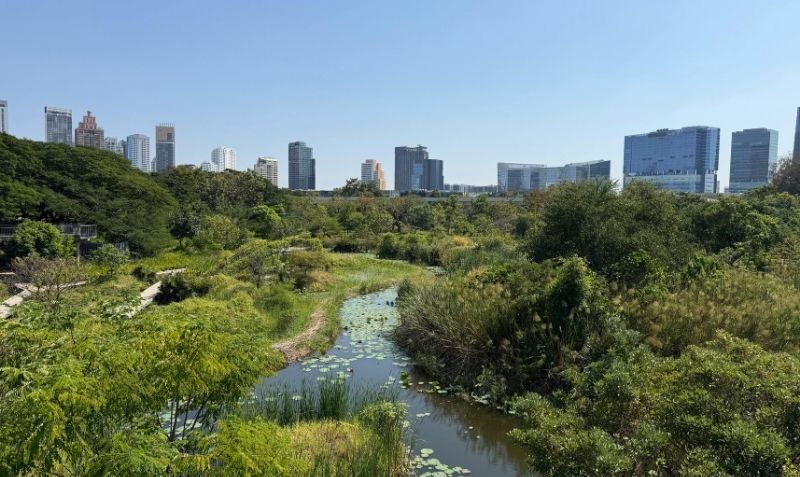
Addressing potential legal risks relating to water rights or downstream users is also important. Water reuse can also benefit the environment through indirect potable reuse and nature-based solutions, such as indirect potable reuse via aquifer recharge or engineered wetlands. The cumulative effects of reuse on a basin from many individual projects must be balanced.
Reuse as an integral part of resilience
If we think of resilience as a stool to sit on, then different aspects of resilience are the stool’s legs. Water reuse is one such leg, next to water conservation, desalination (a form of reuse), groundwater management, and stormwater capture (another form of reuse). You can diversify your water resources portfolio by complementing conventional resources.
Reuse’s biggest contribution to resilience is that it reduces correlation risk. When a drought or flood hits rainfall-dependent water sources, such as surface water or groundwater, their quality and quantity are potentially rapidly compromised. Reuse supply, on the other hand, is unaffected, as it is technologically secured and separate from the natural water cycle. So, you can harness the dependability of wastewater to ensure supply reliability.
Reuse’s biggest contribution to resilience is that it reduces correlation risk
It is important to keep in mind the idea of ‘systems thinking’. Knowing the timescale on which infrastructure decisions are made, it's critical to plan for how upstream actions would affect reuse projects, and in turn how reuse projects would affect water resources downstream. Other utilities should be involved where possible to evaluate and make use of synergies, as this is what will make such projects integrative beyond providing just additional water where needed. It’s important to have a partner who can address the big picture, as well as understand the details of the technologies and treatment, such as Waterloop Solutions.
Systems thinking also enables us to choose more holistic solutions. It lets us face the inevitable and not write decisions off as a ‘tomorrow’ or ‘next quarter’ problem, but really requires us to evaluate all options on the table. It is about diversifying the options on the table and thinking outside the box. The latter is trendy, but the former requires more research. It requires sitting down and calculating and thinking things through.
Resilience is patience, not one big push
Explaining the benefits of water reuse is easy, but making the business case requires a bit more work. Water reuse will not be an easy plug-and-play solution in every case. This makes the business case tricky, because it can’t be explained in a 90-second elevator ride.
A large hindrance, which could be reworked into an enabler for reuse, is governance. Instead of waiting for a blueprint and more defined quality requirements from central authorities, countries or regions can already implement projects as needed on the ground by working together with local regulators. The map of global regulations for reuse will remain diverse, but that doesn’t mean waiting for tailored regulations is the only way forward.
Working within loosely specified reuse regulations and demonstrating a history of safe water quality provision will serve as evidence for future regulatory revisions.
Cost is another factor which may work against implementing reuse in certain areas. Fair, but is going all in on one water resource the best strategy for addressing risk? And is the cheaper option always better, especially when making decisions for the long term? Tomorrow, the cost to change things will be higher than today.
But just because it requires more analysis, it shouldn’t be written off. That’s exactly where things get interesting. How can you compile a portfolio to give you the best protection from climate change? Not only do you optimise for return on investment in the classical sense, but you also quantify the positive effects on the watershed, the environment and society surrounding the project.
Yes, it is not easy. If it were, everyone would be doing it. But it is interesting and worthwhile. Water will always find its way around obstacles. It is up to us if we want to be an obstacle or an enabler.