“We want to build something like Uber” - Adam Saffian Ghazali on transforming a future-ready water utility
A good account of water
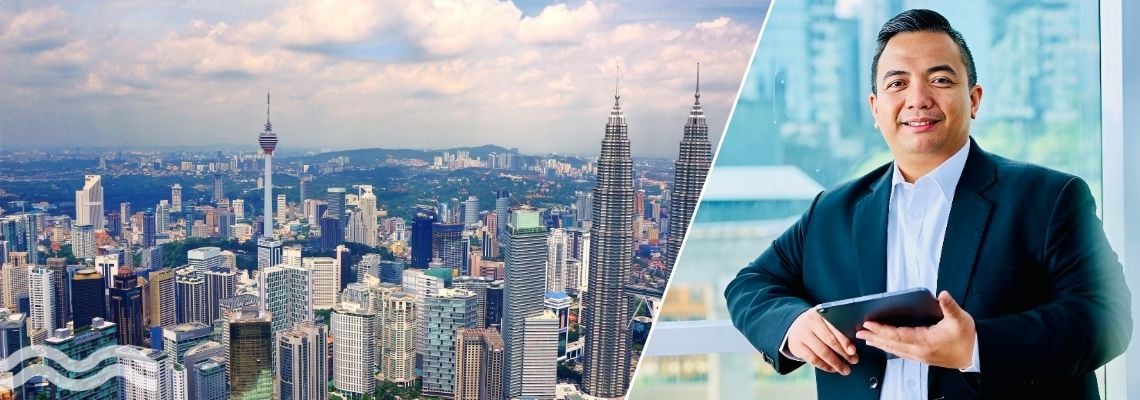
Water is full of engineers. It’s also a good place for accountants, as Adam Saffian Ghazali will proudly tell you.
He was appointed Air Selangor’s CEO in July 2024 at a time when his financial acumen was needed. He stepped into the shoes as the boss of Malaysia’s largest water utility following a major structural overhaul across the nation. Before 2019, five separate water companies served Selangor, Kuala Lumpur, and Putrajaya. The government then merged them into a single entity, called Air Selangor, to drive efficiency and accountability across a service area that sits at the heart of the national economy.
The demand for water will always rise
We are living in a part of the country that contributes 40 per cent of the nation's GDP,” he says. “So, the demand for water will always rise.”
Ghazali had watched the process closely from the inside: he was among the first employees of Pengurusan Aset Air Berhad (PAAB) - the federal government's national water asset company, created to acquire, develop, and lease water infrastructure to licensed operators across Peninsular Malaysia.
Planning for capacity expansion
Today, Air Selangor serves approximately 9.62 million people, relying on surface water from rivers, reservoirs and dams, and operating a vast network that includes 34 water treatment plants and more than 31,000 kilometres of pipes.
Current distributable capacity stands at around 6,500 million litres per day (MLD) against demand of approximately 5,400 MLD. By 2032, Air Selangor has the target of reaching a distributable capacity of 8,000 MLD. This will be driven in part by domestic connections, which are expected to grow at around two per cent every year.
“We have to build capacity in the sense that we have to prepare," he says. "Our target is to be more than 15 per cent reserve margin."
Ghazali explains how capacity expansion is capital-intensive at roughly RM1.5 million (€328,000) per MLD of treatment capacity, which is deliberately phased. For example, to reach 700 MLD, this is incrementally increased, starting at 200 MLD, and then increased to 300 MLD.
Recognised for climate leadership
Testament to the progress so far, in December 2025, Air Selangor was named one of three ‘Outstanding Utilities’ in the IWA Climate Smart Utilities 2025 Recognition Programme, selected from 48 applications across 25 countries.
The CEO identifies three factors he believes drove the recognition: resilience planning; renewable energy; and digitalisation.
On resilience, the utility is in the middle of a major capacity expansion. The Rasau Water Supply Scheme first stage is a 700 MLD treatment plant, drawing on nine former tin-mining ponds repurposed as off-river storage. It’s one of the largest water supply projects in Southeast Asia, designed to end the Klang region's dependence on a single raw water source. A second stage, adding a further 700 MLD, is planned for completion around 2031.
In a few months, we are going to announce that one of our water treatment plants is now Net Zero
On renewables, Air Selangor's Net Zero Energy Vision 2040 targets net-zero carbon emissions by 2040, in step with Malaysia's national commitment to carbon neutrality by 2050. The approach, the CEO explains, starts with quantifying electricity use, then offsetting through on-site generation – primarily solar, with hydropower also under exploration. One plant is already close to crossing the threshold.
“In a few months, we are going to announce that one of our water treatment plants is now Net Zero – achieving the 2040 target at plant level years ahead of schedule.”
The final part of the strategy, digitalisation, completes the picture. In 2019, the utility introduced Microsoft Power BI dashboards to centralise operational visibility across the entire business.
“We know the important statistics about our operation, for example, whether people pay us today, whether we have a pipe burst, and whether the quality of water is not good.”
The data centre dilemma
No conversation about water security in Selangor is complete without addressing data centres. The state has become a magnet for hyperscale investment, which can be seen as both an economic and revenue opportunity and yet also a supply planning challenge.
Ghazali is direct about prioritising Air Selangor’s residential customers.
“Providing water to our 2.5 million domestic customers is non-negotiable – they need water,” he says adamantly. “We must also be able to provide water to data centres, if approved by the government as a license holder.”
One answer lies in differentiated tariffs, which are negotiated with the regulator. For example, residential customers in the first band pay RM0.65 (€0.14) per 20,000 litres (20m3), with the highest non-domestic rate jumping to RM3.83 (€0.84). In comparison, data centres pay RM5.31 (€1.17) per 1,000 litres. In short, tiered water pricing that helps to fund capacity expansion without the utility burdening existing household consumers.
The CEO calls this a “good deal”, adding that “we need to make sure that the water to our domestic customers is not jeopardised”.
A digital utility in the making
Air Selangor's ‘digital drive’ is structured around three pillars: assets; workforce; and customers.
On assets, the ambition is to move from a reactive to a predictive approach. “Previously, we only did maintenance when things broke,” he says. “Understanding how assets behave over time changes that approach entirely.”
On workforce, the challenge is partly generational. With roughly half of staff aged 50 or above, digitisation is as much a talent strategy as an operational one. “It is difficult to get people to work in the water industry because they just say it is not sexy,” the CEO acknowledges.
To close that gap, Air Selangor implemented a digital twin at its Semenyih 2 treatment plant. This is a 100 MLD facility that operators can now run from a laptop or iPad, he says. Furthermore, mobile tools have also transformed field operations: meter readers equipped with smartphones now photograph and transmit readings directly to the command centre.
Building an Uber platform for vetted plumbers
Customer engagement is something Ghazali is passionate about. The utility has rebuilt its mobile application, now called Air Selangor 2.0. People can calculate their consumption in litres per capita, per day and benchmark it against the national target of 180.
“Usually, all our customers beat the average,” he says with pride.
The app also provides access to a rated directory of vetted plumbers, with a review mechanism deliberately designed to mirror ride-hailing platforms. “We like to do something like Uber,” he says.
We like to do something like Uber
A single operational philosophy runs through every strand of the digital strategy: detecting problems before customers do. “People are angry because they call you and say that I don't have water,” Adam says. “But if you can know the problem first, then I think people will try to understand what you can do [to help fix the problem].”
Air Selangor wants to drive investment to achieve real-time hydraulic modelling across the network, eventually driving the goal of triggering automated contractor dispatch the moment an anomaly is detected.
Improving customer service scores
Clearly, Ghazali is a numbers man and loves data, especially as metrics to measure improvements across the business. According to the CEO, Air Selangor's CSAT (customer satisfaction score) rose by three percentage points from 2024 to 2025.
“When I joined Air Selangor, I told the team that we need to make sure that we can deliver treated water when our customers want it,” he says. “The second phase is how do we elevate our customer experience. People can like you for 99 per cent of the time, but suddenly, when they have issues, even that one per cent of the time, they will immediately post on social media.”
For a utility serving the economic heartland of Malaysia, Air Selangor, like all utilities, will face challenges as it builds a future-proof water utility. Ghazali may come from an accounting background and run the biggest utility across Malaysia, yet his positivity is infectious. He wants to ensure that even those one per cent of dissatisfied customers are helped.
Manila Water surpasses global benchmarks in water loss reduction
Seawater carbon removal: Building world’s largest demonstration plant in Singapore
Photochemical oxidation could create sustainable energy from water
Wave power pilot project given green light in Taiwan