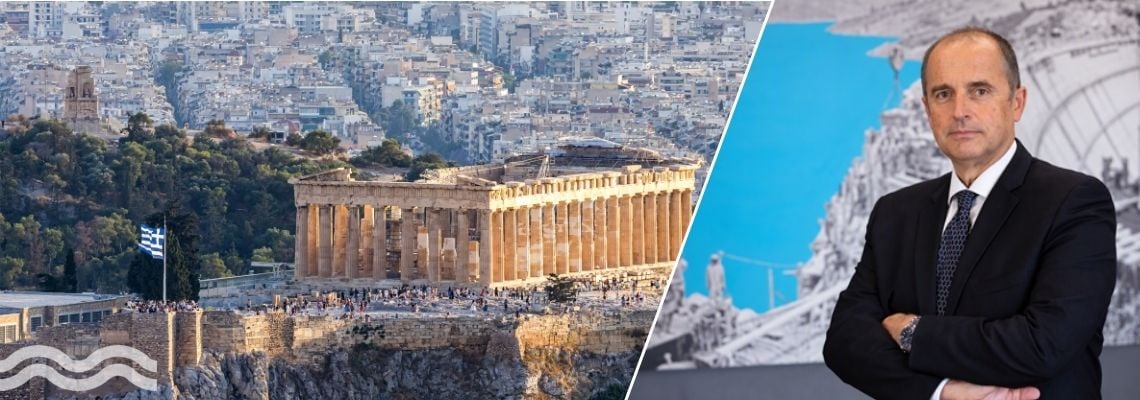
Layer by layer: EYDAP's Harry Sachinis on futureproofing Athens' water
Harry Sachinis spent years lobbying for a regulator to oversee his own company. Now, the EYDAP chief executive has around a year to absorb 43 utilities and take on irrigation, under a new law. He tells Tom Freyberg about a €2.8 billion investment programme, plans for fourth-stage treatment at Greece’s largest wastewater treatment plant and why one pumping station dig went all the way back to the Neolithic.
Repairing leaks: first the archaeology, then the pipes
When most water companies dig up roads to repair leaking pipes, or break ground on the foundations of new infrastructure, the associated disruption can be inevitable. Whether adding to roadworks and traffic, or working around telecommunications lines, it’s par for the course for water works. In Athens, there is another factor: archaeology.
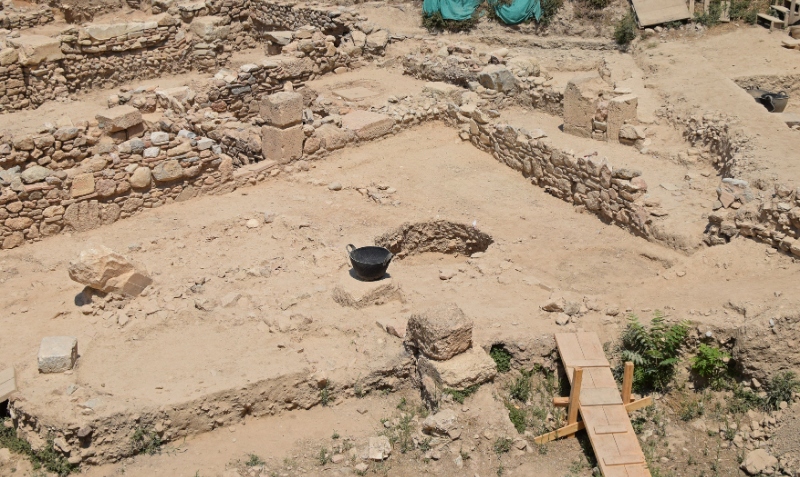
EYDAP, the Athens Water Supply and Sewerage Company, has around 300 archaeologists working across its sites. One example: the utility began work on a new wastewater pumping station at Rafina, east of the city, when archaeologists found coins from the 1800s. Work was brought to a standstill. Further digging led to a Byzantine church being discovered, and then Roman remains, Hellenistic, ancient Greek, until the excavation reached Neolithic findings. Only once the archaeologists had finished could work on the pumping station resume.
“It took two years, layer by layer,” says Harry Sachinis, chief executive of EYDAP.
The water utility delivers around €100m of projects a year, and archaeologists must be present at every excavation. For a CEO who likes to move quickly, this must be a test of patience. The utility is 51 per cent owned by the Greek state, with the remaining 49 per cent listed. It serves 40 per cent of the Greek population, including 4.4 million customers with drinking water and 3.5-3.7 million people with wastewater services.
Forty-three utilities in a year
Yet under a new law it will soon become much larger, as the utility is preparing to take on around 20 per cent more customers by absorbing 43 municipal water services within a year. Sachinis is keen to get moving, and moving quickly. On the day of this interview, he had finished meeting with three mayors about joining the EYDAP group, with one of them responsible for a region that quadruples in population over the summer months.
Reflecting on conversations with partners and consultancies helping with the transition, he comments: “I said I don’t want you to give me a team of 10 people; I want you to bring a team of 100 people so we can do this quickly.”
I want you to bring a team of 100 people so we can do this quickly
The law in question, Law 5325/2026, will also formally bring irrigation into EYDAP’s remit. In the new areas it’s taking over, the irrigation functions of local land improvement organisations will pass to EYDAP, unless members vote to opt out within six months. The change will mean the Athens utility will have to guarantee an uninterrupted supply of irrigation water, and set irrigation tariffs area by area, balancing the viability of farming against the need to save water.
For Sachinis, it fits a broader view: “The way we think about water is we need to think about all of water and about the whole cycle of water.”
Digging into the past
Given Sachinis’s tight grasp on numbers, it would be easy to assume he came to the role as a finance guy. Yet this is too simple an explanation, especially for a man whose career spans engineering, publishing and finance.
Trained as a mechanical and industrial engineer at the National Technical University of Athens, he completed his MBA at Harvard Business School. After landing a role at energy and commodities information provider Platts, he says he grew the business from $30 million to around $300 million in revenue.
Coincidentally, and perhaps foreshadowing his entry into water, during his time at Platts, the organisation acquired Financial Times Energy, which had a small water publication at the time, with 50 to 60 subscribers, as the CEO recalls. Despite a lack of growth, the water publication eventually became part of Global Water Intelligence (GWI): so even before joining EYDAP, water was part of Sachini’s world.
What I like doing is changing the environment, changing the industry
He went on to run large information groups in aerospace and defence, before becoming chairman and CEO of DEPA Group, the Public Gas Corporation of Greece. According to his official biography, he improved profitability there and negotiated major supply contracts worth $20 billion.
He has also worked in private equity, as a partner at Global Finance and an operating partner at Advent International.
Running a fast-growing utility clearly draws on three of his experiences, from data at Platts, finance in the private equity world and managing major infrastructure at DEPA.
Taking tariffs out of politics
It’s rare to come across a CEO who asks for more regulation. Yet Sachinis spent his first years at EYDAP doing exactly that. When he arrived, there were no rules governing how water services were priced in Greece. Tariffs were set by ministers, and EYDAP answered to three ministries: one for drinking water, one for wastewater and one for building projects.
“What I like doing is changing the environment, changing the industry,” he says.
Over three to four years, he lobbied to make the case for an independent regulator. Setting it up, writing the framework and approving tariffs took roughly another year each.
Water regulation now sits with the energy regulator, RAAEY. Sachinis says that makes sense, because energy is EYDAP’s second-largest cost after staff. Instead of three ministries, he now deals with one regulator and one ministry covering water, wastewater and energy. EYDAP, he says, was the first water company in Greece to have its tariffs approved under the new framework.
You know that you can make the investments and you’ll be paid for those investments
This framework compensates EYDAP for depreciation and earns it a return on new investment. That matters for a company with ageing networks which, by Sachinis’s account, historically under-invested.
“If you need to provide the services, you cannot provide them with no money,” he says. The question was always whether customers or taxpayers paid. Now, “you know that you can make the investments and you’ll be paid for those investments”.
Non-revenue water, at around 24 per cent, is one area that stands to benefit, with Sachinis wanting it to be lower. The certainty of cost recovery also underpins the scale of what comes next: a multi-billion-euro investment programme.
Managing a €2.8 billion investment budget
As if merging more than 40 additional water companies isn’t enough to contend with, the CEO is also responsible for leading EYDAP’s investment programme. Slated at €2.8 billion and extending beyond a 10-year horizon, how will the budget be allocated?
Sachinis splits it across three areas. For drinking water, that means replacing old pipes, scaling smart meters from around 80,000 to 2.2 million, and building new mains to coastal areas where the population has grown. On wastewater, it means replacing and fixing old sewers, as well as a Psyttalia upgrade of €300m-plus following an engineering study. And finally, large projects, including sewer networks and new treatment plants for East Attica.
“There’s no sewer network there, so we’re building a sewer network and new wastewater treatment plants. Just to give you an idea, the length of the sewer network is about 1,500 kilometres, which is more than from Athens to Budapest,” adds the CEO.
Psyttalia and the economics of reuse
EYDAP runs the Psyttalia plant, which is gargantuan. For perspective, Sachinis describes it as the second largest wastewater treatment plant in Europe, processing around 400 million cubic metres per year and discharging around 300 million cubic metres of treated effluent to the sea.
A tender has been issued for an engineering study for the next phase of Psyttalia: fourth-stage treatment and a step up in energy recovery. The plant already produces electricity and biogas, with the latter used to dry sludge. The next level is burning the sludge and optimising biogas and power output. Any surplus energy would be sold, with proceeds used to lower tariffs.
Given the plans for fourth-stage treatment, and the volume of treated water already leaving the plant, the obvious question is whether that water could be reused.
Yet there is something of a paradox at Psyttalia: it sits on an island, with Athens ringed by mountains. Reusing its water, even for non-potable uses, would mean pumping uphill and digging a new network through the city, which may cost more than bringing gravity-fed fresh water from EYDAP’s existing source far away. The CEO puts it down to simple economics.
“Even though I may clean it further, I may still throw it away because it is more economical to throw it and use other water that’s fresh,” he says, before adding: “If something happens and there’s absolutely zero water coming from 300 kilometres away, then it will be ready for us to use”.
Overcoming record drought, and the lessons it left
In Athens, the topic of drought never fully goes away. It was in November 2025 when Attica was declared in a state of water-scarcity emergency. For context, reserves across EYDAP’s four reservoirs fell from more than one billion cubic metres in 2022 to around 390 million cubic metres by January 2026.
Experts compared it to the crisis during the period between 1988 and 1994, the last time the capital came close to running dry. EYDAP drew up short-, medium-, and long-term plans.
The first moves were operational. EYDAP brought Lake Yliki, normally in reserve because its water has to be pumped, back into the system. Furthermore, groundwater pumping stations were switched on, with some restarted after around 30 years.
“It wouldn’t save the day,” Sachinis says of the restarted stations, but they provided significant volumes.
The long-term answer lies further west. The Eurytos project, budgeted at €535 million, will partially divert two rivers in Evrytania into the Evinos reservoir. A later phase could link the system to Lake Kremasta, Greece’s largest reservoir, which is currently used for hydropower. “We knew that we would not run out of water if we did that,” he says.
It’s one thing to feel safe and another thing to feel comfortable
Although desalination was held back as an emergency option, fortunately the rains came. A run of winter storms nearly doubled EYDAP’s reserves, from 402 million cubic metres at the start of October 2025 to more than 770 million by late April.
Speaking at the World Water Day 2026 Forum in March, EYDAP chairman Giorgos Stergiou warned that “the problem has not been solved, nor should we be complacent.” He argues that long dry spells are increasingly followed by intense downpours that do little to refill the reservoirs.
“It’s one thing to feel safe and another thing to feel comfortable,” Sachinis says. “Now I feel comfortable that we won’t face an issue.”
Asked whether EYDAP could one day become a single national utility, the CEO points to Ireland, where bringing local water services together into Uisce Éireann took around a decade. With 43 utilities to absorb and more municipalities already asking to join, the total could reach 50 or 60, he says, but he will not be drawn further.
“Let me get this done right,” he says. “One step at a time.”
For a chief executive who likes to move fast, in a city where any trench can open onto another century and subsequent project delays, the approach to the utility consolidation is a fitting one: layer by layer.
The article is part of a strategic partnership between Aquatech Global Events and the Leading Utilities of the World (LUOW). Previous articles include:
Raising a glass to water reuse across Portugal with Nuno Brôco
Why Paul Sciuto bet Monterey One Water’s name on reuse
From engineering to executive – How Kishia L Powell is transforming WSSC Water
“We want to build something like Uber” – Adam Saffian Ghazali on transforming future-ready water utility
Breaking water siloes in California and beyond – Joone Kim-Lopez
Share your water story with us
Share your water technology stories with us
Do you have an innovation, research results or an other interesting topic you would like to share with the international water technology industry? The Aquatech website and social media channels are a great platform to showcase your stories!
Please contact our Sr Brand Marketing Manager Annelie Koomen.
Are you an Aquatech exhibitor?
Make sure you add your latest press releases to your Company Profile in the Exhibitor Portal for free exposure.