Funding fuels on-site pathogen detection expansion
Lab analysis could well be a thing of the past, at least when it comes to analysing water quality. What used to take days, sometimes weeks, is now taking minutes. Early detection of pollution events and of the spread of viruses and bacteria has the potential to save lives, to speed remedial action, to pinpoint sources of pollution, and to reduce both operational and environmental costs.
Portable detectors, modular systems and digital technology are bringing near real-time results into the market. In this Tech Dive, we catch up with some of the companies we have covered in the past year or two to find out how the technology is developing and what the future holds.

Polluted rivers, PFAS, and regulatory changes
In recent years, we have seen the rise of PFAS, or rather, the regulatory drive to remove PFAS and other pollutants, such as pharmaceuticals and microplastics, from the environment and from our drinking water. The recently revised Urban Wastewater Treatment Directive introduces a regulatory requirement to add a quaternary treatment stage to wastewater plants of certain sizes to remove these contaminants that are so harmful to life. However, approximately 80 per cent of all wastewater is still released into rivers, lakes and oceans without any treatment. This includes both human and industrial waste, and is estimated to cause 485,000 deaths annually and lead to economic losses totalling approximately $252 billion.
Chemical analyses of water bodies have revealed alarming levels of human, industrial and agricultural contaminants – such as hydrocarbons, drug residues, and nutrient salts like nitrates and phosphates. These damage rivers and coastal waters, water-based ecosystems and water quality, and they have been linked to serious health issues in humans, such as immune system weakening, reproductive issues, congenital anomalies, and cancer.
Accurate measurement of these pollutants, conducted in laboratories using complex techniques like mass spectrometry and chromatography, is slow, expensive, infrequent, and reactive, often taking many days or weeks to reveal contamination has occurred.
One of the big problems with delayed confirmation of a pollution event is that the risk to the public and ecosystems has been ongoing for some time. A good example of the need for speed came during the COVID-19 outbreak. Dutch microbiologist Professor Gertjan Medema was awarded the prestigious Lee Kuan Yew Water Prize 2024 for his work on virus detection in wastewater during the COVID-19 pandemic. His detection alerted authorities to outbreaks faster than clinical testing.

How has the market changed for portable/mobile rapid detection sensors over the past 12 months?
Over the past 12 months, the market for portable and mobile rapid detection sensors has grown quickly, driven by demand for real-time, on-site data across various sectors.
Nick Thompson, cofounder, WATR, told Aquatech Online: “The market has accelerated significantly, driven by growing demand for real-time, field-based analysis across environmental monitoring, industrial safety, mining, and water management. Customers increasingly expect faster decision-making at the point of need, reducing reliance on laboratory testing and lengthy turnaround times.”
Vincent Bouchiat, CEO at Grapheal, agreed, adding: “Data analytics, AI-assisted post-processing, and cloud-based data logging are increasingly becoming standard features rather than differentiators. Buyers and investors now expect modern sensor platforms to intelligently process data, deliver real-time insights, and integrate seamlessly into broader monitoring and compliance systems.”
Customers increasingly expect faster decision-making at the point of need, reducing reliance on laboratory testing and lengthy turnaround times - Thompson
David Lloyd, CEO and cofounder, FREDsense, agreed that the PFAS market was driving accelerated adoption: “End users are increasingly looking for actionable field data in real time rather than waiting days or weeks for centralised laboratory results.”
He added: “In the PFAS market specifically, the industry has shifted from awareness and investigation toward operational decision-making. Industrial operators, consultants, and government agencies now need tools that support rapid screening, site prioritisation, treatment optimisation, and ongoing compliance monitoring directly in the field.”
Stricter environmental regulations, especially around PFAS monitoring and remediation, are also accelerating adoption.
“In Europe, new PFAS-related regulations are requiring industrial emitters to measure and declare PFAS concentrations more systematically,” Bouchiat continues. “Advances in portable PFAS detection technologies now allow measurements at a much finer level of granularity, enabling operators to move from monthly sampling campaigns to multiple measurements per day.”
The industry has shifted from awareness and investigation toward operational decision-making - Lloyd
Portable systems also have the added advantage of optimising activated charcoal filter lifetimes.
Bouchiat explains: “Historically, filters were replaced on a fixed schedule without clear visibility into their remaining effectiveness. Portable detection systems now allow operators to assess filter performance accurately, extending usable lifetime where appropriate and generating significant operational savings.”
And moving forward, Bouchiat believes portable sensors could also be used for incoming waste streams, as part of the PFAS polluter-pays regulations set out by the EU.
He said: “Portable detection also has the potential to create new opportunities in wastewater treatment and industrial billing models. Treatment plants traditionally dose chemicals preventively, based on assumptions about incoming contamination levels. In industrial wastewater management, incoming waste streams are already tested for contaminants such as heavy metals or cyanide before processing. PFAS measurements could be integrated into this workflow, allowing treatment facilities to bill customers more accurately based on contamination levels. This could become a meaningful new revenue stream for wastewater treatment operators.”
Portable detection also has the potential to create new opportunities in wastewater treatment and industrial billing models - Bouchiat
What market factors are driving the need for portable/mobile rapid detection sensors?
Several market forces, such as PFAS regulations, are driving demand for portable and mobile rapid detection sensors.
Bouchiat explained: “Tightening environmental regulations are creating a strong need for more frequent, distributed, and real-time monitoring capabilities. Traditional laboratory analysis alone cannot support the sampling density increasingly required by regulators and operators.
Industries are also under growing pressure to optimise operational efficiency and reduce treatment costs.
“Real-time field measurements enable more precise process control, predictive maintenance, optimised filter replacement cycles, and targeted chemical dosing,” Bouchiat adds, before cautioning that while AI has emerged as a powerful engine for analysing massive volumes of environmental and industrial data, the sector still faces a fundamental limitation: insufficient high-quality field data.
Traditional laboratory analysis alone cannot support the sampling density increasingly required by regulators and operators - Bouchiat
“AI systems are only as effective as the datasets they are trained on,” he adds. “There is therefore a growing need for denser and more reliable spatial and temporal sampling. This is where portable field monitoring and field sensing technologies can play a critical role.”
Lloyd points to several factors, including:
- Increasing regulatory scrutiny around PFAS and emerging contaminants
- Growing pressure to reduce analytical turnaround times
- Demand for higher-frequency monitoring and real-time decision-making
- Need for rapid field screening to reduce unnecessary confirmatory laboratory testing.
He adds: “For many organisations, especially those managing large infrastructure or remediation programs, portable detection technologies can substantially improve operational efficiency and reduce overall project costs. Another interesting driver is waste reduction, because the cost of managing PFAS waste is very high.”
More frequent, transparent, and traceable monitoring has driven adoption of portable systems - Thompson
Thompson suggests industries shifting toward automation, mobility, and lower-cost testing solutions capable of delivering accurate results in remote or dynamic environments, as key drivers, as well as: “Stricter environmental oversight, increasing water scarcity concerns, ESG reporting requirements, and the need for continuous operational monitoring.”

Have regulations played a part in the development of portable/mobile rapid detection sensors?
As mentioned above, regulations are creating opportunities for innovation in sensor development.
David Lloyd: “Regulations have been one of the primary catalysts for innovation in this space,” asserts Lloyd. “As PFAS regulations continue to evolve globally, organisations are under increasing pressure to monitor more sites, more frequently, and often at lower action levels. Traditional laboratory analysis remains essential, but it can become difficult to scale economically and operationally.”
He adds: “This has created strong demand for complementary rapid screening technologies that can provide faster insights and support field decision-making. Regulatory momentum has also helped validate the need for new analytical approaches and accelerated adoption discussions across multiple industries.”
Regulations have been one of the primary catalysts for innovation in this space - Lloyd
Thompson agrees that the demand for “more frequent, transparent, and traceable monitoring” has driven adoption of portable systems capable of delivering reliable, real-time data directly in the field.
“The EU DWD January 2026 deadline is the most concrete demand signal: thousands of utilities now legally need to monitor PFAS,” said Bouchiat. “The current gap is that the gold standard method, i.e. (LC-MS/MS ), remains the only validated analytical tool — creating a large near-term market for screening devices that reduce the number of full lab analyses needed (i.e., a triage/confirmation role for portable sensors, not necessarily full regulatory compliance replacement).”
TECH solutions: Rapid contaminant detectors
WATR
How has your technology changed in the past 12 months?
Over the past two years, we have expanded our recommended sensor suite while integrating a broader range of third-party technologies. This has increased flexibility for customers and reinforces WATR’s sensor-agnostic approach, enabling tailored solutions across diverse monitoring requirements.
What are the latest developments in your detection technology?
WATR combines proprietary sensor technology with partnerships across leading sensor manufacturers, allowing us to match the most appropriate detection capability to each use case.
Recent development has focused on improving the performance, durability, and deployment flexibility of our in-house sensors, particularly for long-term use in challenging water environments. At the same time, we continue to expand third-party integrations to ensure access to the latest innovations in water quality, infrastructure monitoring, and environmental sensing.
This dual approach ensures WATR delivers adaptable, future-ready detection solutions across a wide range of operational needs.
How has the product developed commercially?
Over the past 12 months, WATR has experienced strong commercial growth, driven by increasing demand for real-time, portable water monitoring that reduces reliance on lab-based testing.
We have expanded both our product and platform offerings, including WATR Pulse and the WATR Pumped Kiosk, while scaling deployments across the UK, Europe, the Middle East, the US, and Australia.
This growth is underpinned by our sensor-agnostic model and expanding in-house capability, enabling us to support a wider range of use cases and environments.

What pollutants does WATR typically detect?
WATR covers a broad range of water quality indicators and contaminants, including:
- Core water quality parameters such as pH, turbidity, dissolved oxygen, and conductivity
- Nutrients, including nitrates, nitrites, orthophosphates, ammonia, and ammonium
- Organic and industrial pollutants such as hydrocarbons and chemical residues
- Heavy metals, including lead, mercury, arsenic, and cadmium.
As a sensor-agnostic platform, WATR can integrate any commercially available sensor to meet specific customer requirements. We typically focus on parameters most relevant to environmental compliance, public health, and industrial process control.
What is the detection technology?
WATR is designed to operate across virtually any water environment. Rather than relying on a single sensing method, it integrates environmental, chemical, optical, acoustic, and IoT-based sensors into a unified system.
These sensors monitor parameters such as water quality, contamination events, flow dynamics, temperature, turbidity, dissolved oxygen, algae activity, and infrastructure performance in real time. The platform supports both WATR’s proprietary sensors and third-party technologies, protecting customer investment while enabling continuous innovation.
To ensure reliable operation in diverse environments, WATR supports multiple communications methods, including cellular, satellite, and LoRa connectivity. This enables secure data transmission from urban infrastructure through to remote, off-grid locations globally.
The result is a scalable, resilient monitoring ecosystem delivering real-time visibility and actionable intelligence across the water sector.
What environments is it designed to work in?
The WATR Pumped Kiosk is a durable, solar-powered bankside solution designed for continuous field deployment. Sampling frequency is typically every 15 minutes, with settings adjustable via software.
Water is pumped from the source at configurable intervals, where a multiparameter sonde records water quality data. This is transmitted to the cloud via GSM, LoRa, or satellite, depending on site remoteness.
Alerts are triggered automatically when predefined thresholds are exceeded. Data can be viewed and analysed in the WATR Pulse dashboard or integrated into third-party systems via API.
Does the system come with software?
All WATR systems are managed through WATR Pulse, which controls reading frequency, alerts and notifications remotely.
How quickly are results available?
Results are available in real time, depending on sensor configuration and sampling intervals.
What developments are being worked on over the next 12–48 months?
Key areas of focus include enhanced situational awareness through improved camera integration and visual recognition capabilities, as well as expanded use of data within digital twin environments. These developments aim to improve operational performance, environmental efficiency, and predictive insight through more advanced modelling and analytics.
Company Information
For enquiries: hello@watr.tech
GRAPHEAL
How has your technology changed in the past 12 months?
Grapheal’s PFAST sensor has shown that it can detect long and short-chain PFAS with a detection threshold compatible with the most stringent regulations (i.e. below the 10 ppt limit). The current system gives an aggregated number of PFAS present. We are working on a device that gives PFAS chain length discrimination and have developed a portable sensing platform based on a tablet coupled to a sensing cartridge.
Our technology is based on an array of graphene field-effect transistor sensors, whose sensing elements have their surface selectively functionalised with compounds capable of selectively trapping PFAS.
How has the product developed commercially?
Our product is currently in beta testing in collaboration with large water utilities. We have demonstrated the capability to measure the breakthrough of GAC (granular activated carbon) filter in real matrices in industrial wastewater treatment plants through the detection of PFBA at the 100 ppt level. We anticipate a market launch by 2027.
Is it still solely a PFAS detector, or has the sensor been developed in other areas?
We have validated other types of analysis, such as pesticides and bacteria (E.coli) sensing. The objective is to deliver a customised platform for fast and affordable water quality profiling.
What developments are being worked on for the next 12-48 months?
We are developing our user base, qualifying on-site with user feedback, and expanding our manufacturing capabilities.
What is the detection technology?
Graphene Field Effect Transistor sensing (GFET technology), which is a variant of an electrochemical sensor. This has been shown in numerous academic works to be capable of reaching sub-femtomolar sensitivity.
Is the detector for domestic use or industrial use, or both?
The current line is used industrially, but we are working on an ultra-portable model directly connected to a smartphone that would allow domestic use.
How is the technology used?
The graphene device is coated with a chemical layer that selectively reacts with the pollutant. An array of sensors enables simultaneous sensing and water profiling, well beyond PFAS. PFAST operates with a specific proprietary algorithm and software to treat and display the results.
How long does it take to get a result?
It takes 30 minutes, but we are working on cutting down this time to 15 minutes.

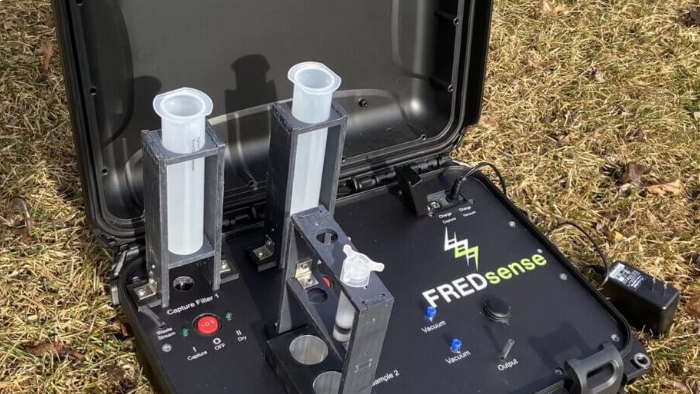
FREDsense
How has your technology changed in the past 12 months?
Since our Series A funding, we have focused heavily on advancing the robustness, portability, field usability, and scalability of our FRED-PFAS™ platform. Much of the development effort has focused on simplifying workflows and improving reliability in complex environmental matrices, which vary widely.
On the detection side, we have continued improving sensitivity, reproducibility, and matrix tolerance for challenging environmental samples.
Our core technology platform combines a polymer-dye displacement assay and fluorescence that rapidly detects PFAS in the field. Over the past year, we have further refined assay performance and expanded our understanding of how the system behaves across different sample types and real-world operating conditions.
We continue to work closely with customers and partners to validate performance in practical applications, including PFAS-impacted groundwater, wastewater, remediation processes, and industrial environments.
How has the product developed commercially?
Commercially, we have seen adoption in Europe, Asia-Pacific and North America.
A major focus for us has been developing flexible commercial models that support recurring monitoring programs and long-term customer adoption.
Is it still solely a PFAS detector?
Our primary commercial focus today remains PFAS detection and monitoring.
The platform is designed to support rapid PFAS screening workflows, particularly for environmental and industrial applications. Our development efforts have focused on the PFAS compounds most relevant to current regulatory and remediation priorities, including longer chains and precursors with a ‘total PFAS’ screening output signal.
What developments are being worked on for the next 12-48 months?
Over the next several years, our focus areas include:
- Improving the limit of detection and quantification
- Increasing automation and ease of use
- Supporting additional environmental and industrial applications.
We also expect the industry to move toward more integrated monitoring ecosystems where rapid field screening, connected data systems, and confirmatory laboratory testing work together more seamlessly.
What environments is it designed to work in?
The system is designed for field and near-field deployment across a range of environmental and industrial applications, including:
- AFFF-impacted water
- Groundwater
- Surface water
- Industrial process water.
How is the technology used?
The technology is designed to provide rapid screening results directly in the field or near-field environment. Users collect and prepare samples, run the assay through the portable detection platform, and receive actionable results significantly faster than traditional laboratory workflows.
The platform is intended to support operational decision-making, site characterisation, treatment optimisation, and prioritisation of confirmatory laboratory testing.
Does the sensor come with associated software?
Yes. The platform includes proprietary firmware for instrument operation, workflow management, and data interpretation.
How long does it take to get a result?
Time-to-result depends on the application and sample matrix, but the system is designed to deliver rapid screening results, within 3-4 hours, with the ability to run multiple samples simultaneously.
The platform currently supports PFAS screening workflows and is designed to provide actionable concentration-based insights rather than full laboratory speciation.