What's it like to recruit in water: simple, but complicated
Everyone in the water sector knows what the grey wave * means. They also know the impact the loss of experience and expertise could have in the coming years, as we tackle even greater challenges involving water quality, availability and security.
However, the solutions are not always obvious, certainly not compared to the problem itself. In many ways, the grey wave (to labour a pun) is merely the surf crashing on the shore. Water tech is amazing, but it has to compete in a competitive careers market that includes all manner of exotic technologies that, in many cases, seem to offer more lucrative rewards.
While we wrestle with how to attract bright minds to the sector and keep hold of our experienced heads, one word is often missing from the conversation.
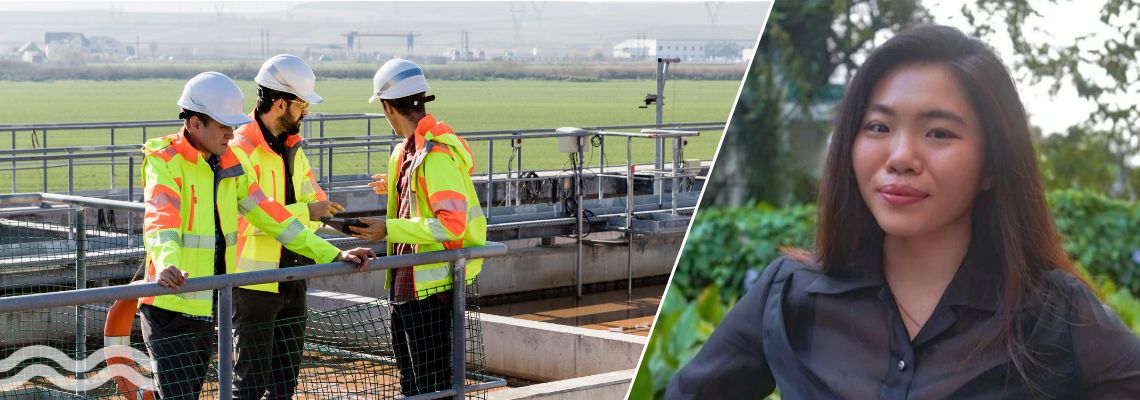
In this latest Rising Stars article, we address that oversight and take a look at recruitment in the water sector. Based in Singapore, Laura Chan is vice president for LVI Associates, where she leads the executive and specialist recruitment arm of the water sector in Asia Pacific. In this wide-ranging conversation, she talks all things ‘recruitment’ with Aquatech Online.
Recruitment means being part of bigger equation
Laura begins by describing her role as ‘sitting within the intersection of helping businesses attract, identify, and secure the talent that they need to achieve their ambitions’.
“On a daily basis, I partner with engineering, consulting firms, utilities, technology providers, contractors, investors, everywhere across all walks, to find people who will lead critical projects and shape the future of the industry,” she explains.
One of the biggest obstacles, she adds, is “talent scarcity.”
“Everyone has ambitious plans,” she continues. “Everyone has a short timeline to fix climate resilience and water security; their pipelines are about to burst any moment. And I think for me it's: how can I help to be one part of that bigger equation and try to bridge the gap.”
Resistance to recruiting from other sectors
One obvious place to look, you would think, is for talent currently working outside of the sector. But this can prove difficult.
“I would love to bring in people who are non-water related,” she begins. “However, water is a highly specialised market. Everyone knows everyone and is closely connected. And if you don't have the legacy or credibility to run a certain project, it's difficult to get the buy-in from leadership to say they trust you to do it.”
This resistance comes from direct experience.
“Leadership teams have told me, Laura, somebody who built roads, they are not the same skill set as somebody who can build a water treatment plant.”
There is less resistance when it comes to digital technologies, where skill sets are seen as more transferable.
“I think we are a bit more accepting and a bit more realistic with who we can bring in because it's so new,” she explains, “and you need to pull in resources from GIS specialists, AI engineers or data scientists that can help to decode and build the models to run digital water effectively.”
Passion overcomes profit
As we have touched on already, recruiting into the sector can sometimes seem like a battle against more ‘showy’ sectors.
“I've been asked the same question recently,” Laura begins. “I said, when you are a mid-level career engineer and a data centre role comes up versus a water role, which one would you choose? Realistically, the data centre or renewable energy project can often command higher compensation than comparable roles in water. So, it's a hard sell.”
However, it’s not all doom and gloom, as Laura explains.
People in water are the most passionate that you would ever meet
“Why are we here?” she asks. “Despite sometimes offering lower salaries than data centre roles on average, the people in water are the most passionate that you would ever meet. Hands down, there is an innate desire to do better for the environment and a desire to give back to the community.”
She adds: “I think that is exciting and that's what people stay for.”
Added to this passion is the practical reality that “water will never go anywhere”, which means that projects are consistently available.
A career that led to water recruitment
Like many people who work in water, Laura’s story takes a path that, when viewed from a distance, seemed always likely to lead to the sector… and recruitment.
“I spent six years studying psychology and thought my career would entirely focus on understanding people and human behaviour,” she says. “Along the way, I discovered recruitment and realised it combined exactly what I enjoyed the most: Psychology, relationship building, problem solving and helping people with significant career decisions.”
She has now spent more than six years specialising in the water industry.
“I think looking back, it makes perfect sense. I’ve always been fascinated by climate resilience and the ocean; I love diving, environmental sustainability, and the role that water plays in society. I think it’s a combination of something I’m good at, something I'm passionate about, and the thing that pays the bills.”
Recruitment is simple, but complicated

As Laura says, understanding what drives people and how they build relationships is important in recruitment, both for those hiring and looking for a role. But what does the recruitment process itself look like?
“That's a hard question to answer,” she states. “I think recruitment, in essence, is simple, but complicated.”
Thankfully, this is a juxtaposition that can be easily clarified: “The process is simple, but humans are complicated, as we know.”
“My role sits in the intersection of executive leadership teams, hiring managers, HR professionals and technical specialists. So, each bucket has different needs and different wants and different expectations,” she explains.
Often, clients only reach out to me when it's too late
“I spend my time helping organisations understand what talent they need to achieve their strategic goals and how they can build teams that are capable of delivering them.”
However, the process is not always plain sailing: “Often, clients reach out after a project has been awarded, and we're then tasked with delivering high-quality candidates within very compressed timeframes.”
Laura explains that the role is made more interesting by having visibility across the entire market.
“I speak with businesses about growth plans, challenges, ambition,” she says. “We talk about immediate hiring needs, but also what success looks like over the next 12 to 24 months, five years or even ten years. Then we translate those conversations into practical hiring strategies and business-critical appointments.”
Recruitment may take time to get right
Much of the recruitment process takes place in the ‘background’, often over long periods.
“I may start a conversation with a client today, but I could only see the person starting a year later, for example,” Laura explains. “But that’s not because it took us one year to find the person. It probably took us eight months to conceptualise the need and the aim. People often don’t see that background work we do as recruiters.”
A significant amount of time is spent mapping out the market, understanding where talent is moving, who's winning, who's losing, and which organisations are attracting high performers.
“I always tell people that they need to understand why people are moving,” she says. And I think my psychology background gives valuable insight into all of this. Recruitment is fundamentally about understanding people, their motivations, aspirations, concerns, fears, and what drives them to make that change.”
One of the biggest challenges now is the growing gap between project demand an available talent
She adds: “I think what I enjoy most is seeing someone completely transform the company's trajectory and do the thing we wanted them to do.”
One particular hire stands out for Laura. “A global AI infrastructure business reached out to me to hire their first senior vice president for Asia Pacific,” she begins. “It was a highly strategic appointment and an extremely difficult search because no one had the combination of AI infrastructure plus water plus critical infrastructure in general. So, it was difficult, but we managed to find that person. And within the first year, the executive I placed contributed to approximately $10 million in business growth.”
And making the right hire has added benefits: “My philosophy is hire one good person so that that person can help you recruit your workforce.”
What are the biggest challenges in recruiting in water right now?
“I think this is something that you have heard multiple times: one of the biggest challenges now is the growing gap between project demand and available talent,” Laura states, referring back to the fact that people are being attracted to other industries, or not studying engineering in the same numbers as in previous decades.
One of Laura’s largest markets is Australia, where she has seen organisations coming under pressure to deliver critical infrastructure projects against tighter timelines and budgets.
“Many organisations are really operating on lean teams,” she explains. “As a result, you will see technical leaders and specialists, and construction guys, being asked to wear multiple hats: balancing plates of delivery, client management, mentoring, business development simultaneously.”
The challenge, she says, is not a lack of opportunities or projects; it is ensuring that there are enough experienced people available.
What might the future workforce look like?
With concerns about the loss of knowledge associated with the grey wave, is there another way of keeping experienced people in the sector? Perhaps as consultants.
“I think it's starting to happen even now,” Laura says. “And I think that those guys that have 25, 30 years of experience just want to do good work.”
This stems back to the passion people in the industry feel for their work.
“They're extremely passionate, and they just want to be able to do good work and do it well and try to save some money for the company,” Laura explains, before relating the story of someone who had spent more than two decades in water.
“He spent 20-plus years, from graduate to technical director, and decided to quit like that because he said, I just want to do good projects. I don't want to be bogged down by the politics. And he just walked away. And so now he's a contractor.”
One of the biggest challenges, according to Laura, will be attracting more people to the industry, especially from other industries.
The water industry offers something incredibly powerful: purpose
“We know that water is an incredibly important industry and there’s highly specific technical talent across each small niche and vertical. The pool is small, and then you shrink it down even further, and it’s just one person for one goal, essentially.”\
Water will need to compete against sectors like data centres and renewable energy, which might offer bigger salaries and faster career progression. This could affect recruitment at every level: graduates, interns, mid-career, etc.
“But as I said, I don't think it's all doom and gloom,” Laura says. “The water industry offers something incredibly powerful, which is purpose. If I speak to the younger generation, particularly through my work and collaboration with SWAN’s Rising Smart Water Professionals (RiSWP), I often ask them, ‘What’s keeping you here? Why water?’ The answer is almost always the same: purpose.”
She adds: “I think that’s incredibly powerful because more and more people want careers where they can create a positive impact. Water sits at the heart of sustainability, resilience, and public wellbeing, making it a sector where people can genuinely contribute to something larger than themselves.”
*Sometimes referred to as the silver tsunami.
Share your water story with us
Share your water technology stories with us
Do you have an innovation, research results or an other interesting topic you would like to share with the international water technology industry? The Aquatech website and social media channels are a great platform to showcase your stories!
Please contact our Sr Brand Marketing Manager Annelie Koomen.
Are you an Aquatech exhibitor?
Make sure you add your latest press releases to your Company Profile in the Exhibitor Portal for free exposure.