All aboard the digital transformation of water
Publishing papers in your specialist field is something expected of PhD candidates. But publishing four papers while studying for a Master's degree is going above and beyond expectations. Indeed, it is almost unheard of. If Ammar Riyadh’s journey into water – one that has spanned three continents – and his early career is anything to go by, he certainly has a bright future.
One thing is for sure: it will be a career involving water and the possibilities afforded by machine learning and digital technologies, with the ultimate goal of “looking after the water sector and making sure I can help as many people as possible utilise these technologies for the sake of the environment, humanity, and just overall the whole sector,” he tells Aquatech Online.
Working for Arup
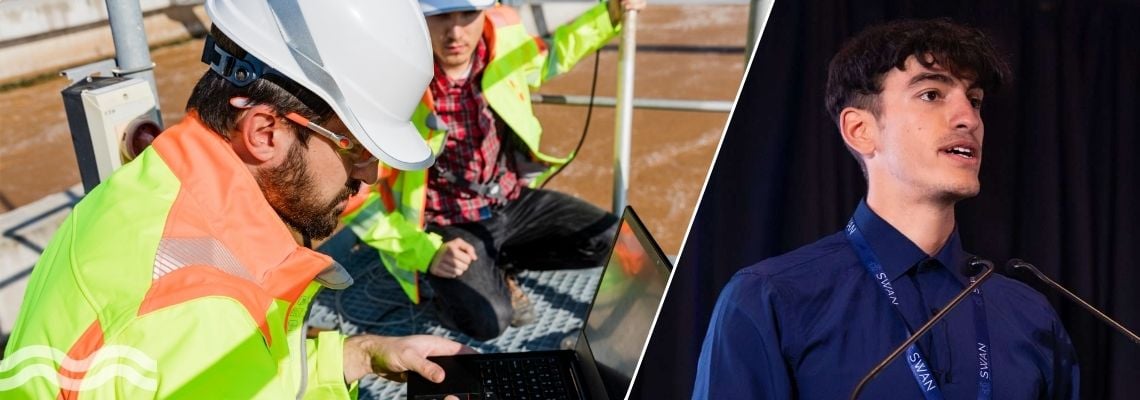
Ammar currently works as an engineer for Arup, within the digital team.
“I work on projects that apply digital tools and analytics to water challenges,” he begins. “This could be a data centre project or stormwater management project, for example.”
His work might focus on digital twins, creating dashboards, essentially helping utilities and organisations undertake a digital transformation.
This transformation is a journey that many utilities and corporations are undertaking, with some further ahead than others. As Ammar confirms, it’s an “amazing” field to be working in.
North America and Europe: an education in water
Talking of journeys, Ammar describes his own route into the water sector as “pretty interesting”. He was born in Saudi Arabia, but his water story began in Canada.
“I studied civil engineering as a degree in Vancouver, Canada,” he says.
While the first two years are pretty general, by the third year he needed to decide whether to follow a structural or environmental discipline.
“Throughout my courses, I took a lot of environmental classes, a lot of water and wastewater classes,” he begins. “I was just super intrigued by the whole dynamic of water because it combined a lot of different subjects and sectors. We were looking at biology, physics, hydraulics, engineering.”
This variety of the environmental path appealed to Ammer, as did the fact that their work was helping communities. “That's where I grew the passion for it,” he says.
This passion fed into a Master’s degree specialising in digital water and the utilities space.
“I worked with a utility in Canada,” he begins, “and they had a bunch of data and a lot of problems. They were looking at chlorine at the time, so my research was how we can utilise their data.”
They had a bunch of data and a lot of problems
This was at a time when data analysis using machine learning and AI was becoming more prominent in the water industry.
“My passion was converging these,” he begins. During his Master's degree, he published four papers as a first author, specifically in digital water and digital transformation based on his work with the utility. “I created a lot of machine learning models working with their data.”
Following his Master’s degree, he continued his journey, literally, with a move from Canada to Europe.
“I moved on to the Netherlands to work with KWR Water Research Institute, in Nieuwegein, Utrecht. I joined their digital team for a while, under the leadership of Dragan Savic.”
From the Netherlands, his journey continued to San Francisco, and now to New York.
Machine learning and communicating AI
AI is already making an impact on the water world, but also has a great deal more potential for helping water companies solve real-world challenges. Just as there are many different types of water challenges, there are various types of AI, including artificial neural networks, which Ammar also used for his Master’s research.
“I developed a bunch of machine learning models for predictive analysis for water utilities, based on their data, looking at prediction of chlorine levels throughout the water distribution system,” he explains. “One of my papers was about the explainability of machine learning, for example, why does the model create this decision? I was looking a lot at their inputs and their outputs, a lot of machine learning models.”
Water utilities have a wealth of data, which requires a lot of cleaning and reduction before machine learning models could be created.
“There’s a lot of data preprocessing for the utilities,” begins Ammar, which can be a learning process in itself for utilities not used to dealing with digital transformation. “I could show them what they have and what could be used, but also what we actually need.”
Aiding the digital transformation
From cleansing and preprocessing to machine learning, the terminology behind AI and data can literally seem like a new language to those unfamiliar with the digital world. It is a fast-moving world that needs specialists to pioneer new ways of working for the water sector.
“In my current role, I'm diving deeper into things like databricks, for example,” he begins. Databricks is a ‘data platform’ – an internet search reveals that it is a unified, open analytics AI platform designed for building, deploying and managing large-scale data, analytics and machine learning solutions… this incorporates data lakes and data warehouses… for many working in the water sector, these are very new concepts.
“I'm looking at automations,” he continues. “I'm looking at developing dashboards for utility clients. My role intersects AI consulting and water.”
This brings into focus one of the great challenges in the water sector: the ageing workforce. Data analytics and digital technologies have great potential beyond the successes we have already seen. However, we will need to encourage digital-fluent talent to the sector to help realise this potential. On the other hand, digital technologies, like digital twins and machine learning solutions, can help to capture the knowledge and the real-world working experiences of the ‘grey’ workforce before they retire or leave the sector.
I'm looking at developing dashboards for utility clients. My role intersects AI consulting and water
All utilities will be at different stages in their digital transformation, as Ammar attests.
“One of the clients I'm working with right now knows exactly what they want,” he begins. “They want this to be developed, they want to utilise this data, and they want to showcase this application.”
When a client is less certain, Ammar acts in an advisory role.
“We're the digital advisor: We can say, show us what you have and then tell us what you want to solve. And then from there on, we're going back to the dashboard. We're trying to analyse, figure out – we can use this, we can use that, etc. And then we present to them: this is what we could accomplish with your data. What do you guys think? It's always client-based.”
Watersheds and digital flood management
As Ammar mentioned, one area he has been working on is automation. For example, some clients are looking at watersheds and how best to develop stormwater management, as Ammar explains.
“They want to understand how the water flows and how to reduce flooding,” he begins. “So, they have a bunch of historical data, and they're trying to design different outlet structures, different control structures for the flooding. We can utilise their historical data to create machine learning algorithms throughout the network. This is more of a graph network that represents the watershed, and that controls the outlet structures: When does it open? Does it open a little bit? Does it open halfway? And so it continuously automates the opening and closing of certain structures so that we can reduce or increase water flow throughout the watershed. I think that's the coolest project that we’re working on.”
Digital water’s biggest challenges
One of the biggest challenges for digital water is the data itself.
“The water industry has an enormous amount of valuable data, but it doesn't mean it's usable data,” Ammar explains. “Utilities have so many SCADA systems, GIS bases, hydraulic models and sets, but before you can really benefit from advanced data analytics, you need a strong foundation and also governance and integration.”
Ammar points to cybersecurity, data governance and the ageing workforce as related challenges.
“I was presenting my machine learning algorithms to a utility in Canada,” he says, “and one of the guys was like, what's the point of this? Why am I going to use this? I’ve been doing this for 30 years; I don’t want to change. So, I think the transformation into the digital sector between the workforce and the data is the hardest thing that we're trying to navigate at the moment.”
Upskilling the workforce to take advantage of the technology may be one of the biggest challenges over the next few years. One thing is for sure: the technology won’t wait for the workforce; it is developing rapidly.
Networking and being an ambassador
Ammar is an ambassador for Swan’s RiSWP (Rising Smart Water Professionals) group, which regularly meets to exchange ideas and to support each other in their early careers.
“Arup is a partner with Swan, and the opportunity arose to join their programme,” he begins. “Me, being me, I'm always ready to join organisations and programmes. If you're telling me I'm going to meet people in this industry, I'm all for it.”
Monthly calls, networking, engagement and volunteering seem like a good fit for Ammar’s career journey so far. His move to the Netherlands highlights his courage in networking and in pursuing opportunities to boost his knowledge and gain experience.
“I was just really intrigued by KWR, the kind of work they were doing,” he explains. “So I just kept on emailing them, saying, hey guys, I want to come work for you for a little term. I explained what I do, and after a couple of calls, they were like, okay, you know what, come over.”
I want to understand what's genuinely useful rather than simply following technology trends
His move to Arup followed a similar path: showing interest and reaching out.
“I think my networking and then my outreach is really what got me around.”
He is clear on where he wants to develop his career over the next 10 to 15 years: “I want to lead teams. I want to lead strategies around AI, especially the digital transformation. And yes, that will be in the water sector, for sure. That is my passion.”
Developing a sound technical understanding is also important: “I want to understand what's genuinely useful rather than simply following technology trends,” he says. “I want to be an expert in AI consulting, in data analysis. And still be involved in the water sector, the organisations, the utilities, making sure that I continuously involve myself in conferences, presentations, networking events, to stay up to date.”
Where will the digital transformation take the water sector?
With the rate of development feeling exponential at times, what do the next few years hold for AI and water? Where are the next developments likely to take place?
“I would say flooding and prediction, utilising historical data to predict weather and rainfall conditions; there is so much that we could achieve,” begins Ammar. “Distribution networks, which is one of the things that I was really looking into, like pipes and water and wastewater hydraulics. A lot of these things can definitely be automated and analysed more easily, because currently the workflow revolves around general engineering. So, AI could definitely start creating hydraulic models, and they're pretty accurate.”
This does not mean humans will be redundant.
“We still need human revision. We still need engineers. We still need experts to look at the models, the data, the analysis, and to make sure things are good to go,” he explains and reiterates the need to upskill the workforce.
We still need experts to look at the models, the data, the analysis, and to make sure things are good to go
“Rolling out learning and development tools and classes and trying to help people understand data and how digital works and digital twins and transformations because the AI expansion within the water sector is going to happen. Whether we like it or not, that's the reality of it. We have to get on the wave; we have to understand.”
Other areas of development will include cybersecurity and governance: “It is going to be a big thing that a lot of utilities are going to have to expand on, just making sure the governance around the data and the security is still censored.”
And one final word from Ammar on what digital tools and machine learning mean to him: “For me, personally, it's just so motivational, inspirational to utilise these tools for the greater cause. I'm not here to present to you a fancy neural network or machine learning model because I think it's cool. I think it's going to reduce costs for the utility. I think it's going to help make sure we have clean water when they open their tap.”