UK has challenging but ambitious CSO monitoring plan
Upgrading the world’s water infrastructure to become digital and smart is both an impressive aim and a monumental task. A smart water network significantly increases our knowledge of what is going on in our treatment plants and wider networks, allowing us to collect more accurate data with which to make informed decisions. This will come at a significant cost and through major efforts, both physical and regulatory.
In this article, Oliver Grievson, Associate Director and Technical Authority, Regulatory Monitoring Service at AtkinsRéalis, looks at smart monitoring from a UK perspective. Water companies in the UK have been challenged to deliver some of the most difficult monitoring programmes the industry has ever seen. While the scale of the challenge is great, the rewards will be even greater.
Having confidence in data quality
“Back in the 1950s, the phrase “Garbage in, Garbage Out” was coined; at the time, computers were in their first generation, and online instrumentation wasn’t going to appear in the water industry for another twenty years.
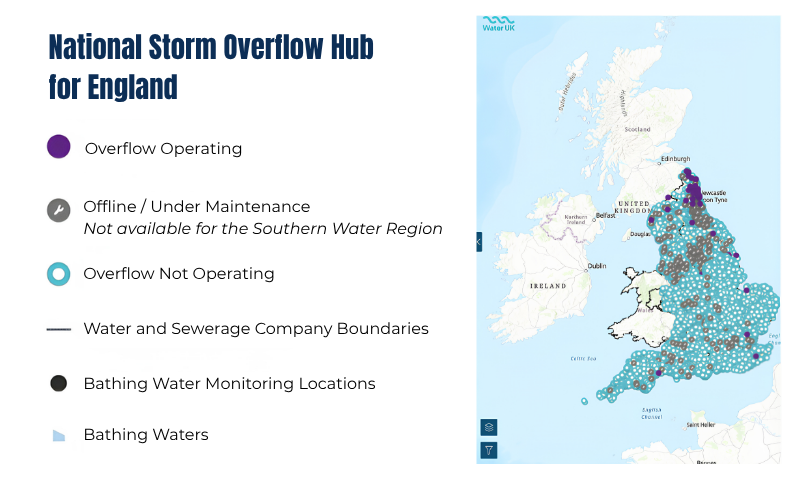
Figure 1: The national storm overflows hub
“However, that phrase has become even more important in modern industry, with the advent of Artificial Intelligence (AI) and Machine Learning, especially within the much wider concept of the digital water industry.
“Only 10 years ago, the wastewater industry had very limited regulatory data, with only wastewater flow monitoring (under the Environment Agency MCERTS scheme) covered by any form of regulatory quality control scheme.
“It was approximately at this time that the main programme of installing event duration monitoring (EDM) on Combined Sewer Overflow (CSO) outfalls began, and over the next eight years the water industry installed close to 14,500 monitors across the country.
“In the modern water industry, all of this data is shared within an hour of an event happening via the national storm overflows hub. Unfortunately, there were no standards governing the installation and no quality control, apart from the evidence packs that were provided to the Environment Agency as part of the deliverables required by every Water Industry National Environment Programme (WINEP).
“The introductory page to the hub itself identifies the data as only an ‘indication’ of what is happening. In fact, a paper by Peter Hammond (2024) called into question the accuracy of the EDM data. In hindsight, the mistake around the delivery of EDM data on CSOs was that they were not brought under the control of the MCERTS programme, which would require certified instruments and periodic inspection of installations to ensure accuracy and management systems to ensure that the data remains accurate.”
What is the MCERTS programme
MCERTS is the UK Environment Agency’s Monitoring Certification Scheme for environmental permit holders. It is used to approve people, instruments and laboratories.
More monitors and increased data collection frequency
“Despite this accuracy, the water industry has been requested to change the 15-minute monitoring in the network to 2-minute monitoring. This, in places, will require significant investment to provide bigger batteries and increased maintenance, all to collect data that is known to be inaccurate in places.
“The industry has also been asked to install even more monitoring. Ten years ago, the number of monitors numbered in the region of 4,000, spread over 3,500 sites, and over the next decade this number is set to increase significantly.
“At the current time, the number of monitors has increased by:
- 14,500 CSO monitors
- Approximately 2,000 level monitors measuring the spill to storm (under the U_MON3 programme)
- 2,000 monitors measuring ‘flow to full treatment’ (under the U_MON4 programme).
“This brings the current total up to approximately 23,000 monitors.
“The remaining are all programmes of monitors that are either due to be installed or predicted to be installed over the next 10 to 15 years, including:
- Monitoring under Section 82 of the Environment Act (2021), approximately 27,000 monitors, measuring water quality upstream and downstream of sewer overflows and wastewater treatment plants
- Monitoring under the U_MON6, measuring the spills from storm overflows and, in some cases, the pass forward flow at approximately 6,000 emergency overflows and 1,000 flow meters
- The potential of final effluent monitoring being installed at all wastewater treatment works that fall under the MCERTS condition is being looked at as a potential way forward.
“Under Section 81 of the Environment Act, there is a duty to share the data produced with the public within an hour of collection, all under open data initiatives, which is a noble concept; in reality, the risk is that there will at least be some error in the data.
“At the moment, the national storm overflow hub works because it is just one piece of data with no other data to contextualise the performance of the wastewater system. However, as we add data points and connect them together, there is a possibility that errors in the data will become more apparent. The statement, as to the indicative nature of the data, will suddenly become more real.”
The importance of data quality
“The national storm overflow hub highlights where CSOs are spilling around the country at any one time. Maintenance of devices happens in the field, but this is not subject to the same scrutiny or maintenance under the MCERTS programme.
“Due to the level of criticality and performance requirements, it would be within the rights of the water companies to ensure that the monitors are working and only fixing them when a battery fails, or the data is missing due to damage to the instrument. As such, these instruments and the data that they produce are rightfully marked as indication only. This is a remnant of their original installation; the water companies were funded to a level where the instrumentation installed was not at the level of diligence a regulatory monitor would be when installed.
“Since this point, the lesson has been learnt, and the future programmes of work (U_MON3, U_MON4 and U_MON6) are being installed and governed by the MCERTS programme. Right now, this isn’t the case; from a regulatory perspective, the most expensive monitoring programme the water industry has seen is governed by the Continuous Water Quality Monitoring Programme under Section 82 of the Environment Act.”
The quality of manufacturing
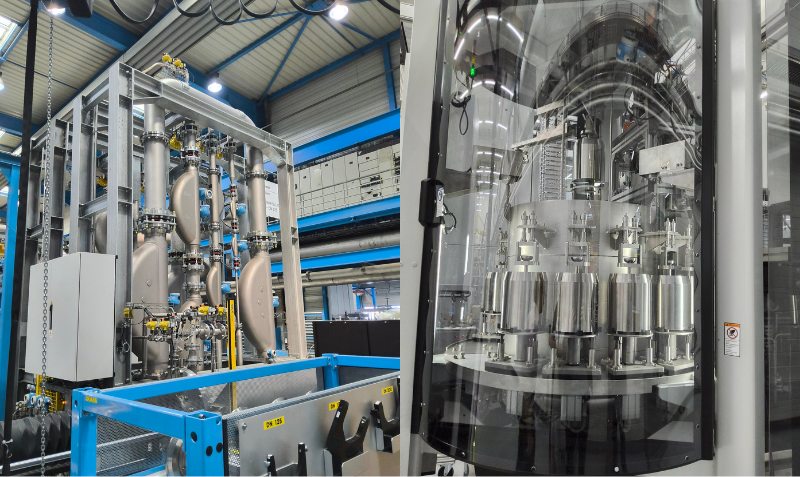
Figure 2: Calibrating electromagnetic flow meters with Coriolis flow meters, which are in turn calibrated all the way back to the international standard measurement, providing complete traceability of measurement.
“Most of the instruments in place within the water industry have undergone rigorous testing and calibration in the factory before they are received by the customer. When you go to the manufacturing facilities of the suppliers within the industry, the amount of diligence that is undertaken to produce an instrument to exact specification is awe-inspiring to see
“A number of the facilities themselves calibrate instruments to ISO17025 – the standard for good laboratory practice, and every element is traceable for the clients. For some industries, this goes down to a level where the materials used in the manufacturing process are traceable to the exact source they came from. In the factory, the instruments are calibrated within instruments that are, in turn, traceable back to both the ‘national standard’ of weights and measures all the way back to international standards. A recent visit to the Endress & Hauser electromagnetic flow measurement manufacturing facilities in Germany highlighted the level of diligence that is undertaken.
“This is an example of traceability, and all of the suppliers have a similar level of diligence when manufacturing instrumentation. In the world of flow measurement, the testing of the instrumentation doesn’t stop here, and under the MCERTS scheme, all of the instrumentation has been through further testing both in the laboratory and in field testing as well.
“It is only at this point that the instrumentation is allowed out into the industry for use in regulatory monitoring. All of the reports of both the laboratory and field testing are brought together and kept as an instrumentation certification report and is fully accessible via CSA who manage the MCERTS Scheme on behalf of the Environment Agency.”
Maintaining accuracy in the field
“Once instrumentation gets into the field, what are the standards and what can be used where? Table 1 shows the various instrumentation applications within the water industry and what governance is present.
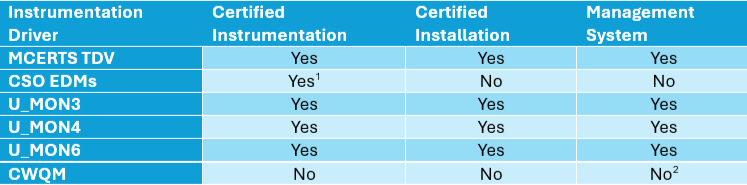
“As we can see, the majority of flow and level measurement is under the MCERTS programme, with the notable exceptions being the CSO EDM programme and the CWQM programme. Considering that CSO EDMs are the only data released to the public in near-real time, it is curious that there is no quality control over this data; thus, it has to be labelled as indicative only and not usable for any purpose other than to indicate that it ‘may be’ spilling.”
What is the CWQM programme?
Continuous Water Quality Monitoring (CWQM) is the near real time measurement of river health using fixed sensors rather than occasional manual sampling. It tracks parameters such as dissolved oxygen, ammonia, turbidity, pH, temperature, and conductivity.
So, what can and should be done?
“For most regulatory monitoring programmes, there is no issue; they are under the MCERTS programme, and quality assurance procedures are in place from manufacturing to management in the field. This is not currently the case for either of the CSO EDMs or, at the current time, the CWQM programme the industry is starting to deliver.
“For network EDMs, there are obvious actions: write an actual installation, operation and management standard, and then implement it across the industry. This can either take time or money to implement.
“Through base maintenance and enhancement funding over the next 10 years, the industry can install network EDM monitors to a certifiable standard, which could bring them under the MCERTS standard. Alternatively, all of the spill monitors could be replaced at the next investment opportunity, but to do so would inevitably require a significant amount of investment. For this type of monitoring to come under the MCERTS programme would also require a significant increase in the number of independent inspectors across the industry.
“For CWQM, there is no such development, apart from work the water companies are doing (using their own investment), installing to a standard that will provide both due diligence and traceability, ensuring the industry is as informed as possible.
“Despite there being no official certification programme, the water companies, led by United Utilities, have instigated a field-testing programme to ensure the water quality monitors used across the industry do what they need to do. In addition, some companies are investigating the limits of the installations and the best way to do it.
“The industry is working in the best possible way to instigate its own level of diligence and traceability. There is also a degree of acceptance across the industry that ‘indication only’ will not be an acceptable level of operation; the traceability of the instrumentation is going to be a fundamental part of the future delivery.
“The programme will eventually invest £300 million per annum to ensure the data keeps flowing and is accurate. At this level of investment, the customer obviously needs assurance that the data shared with them is as accurate as it needs to be; then, hopefully, trust in the water industry, and the way it operates, can eventually be restored.”
The need for accurate information
“In this article, we’ve looked at the need for accurate data and the methods that are taken to ensure that the data that is produced for the industry is right. The accuracy of the data that is collected is a fundamental part of the operation of the industry for many reasons:
Situational awareness – It is important for the water companies to know what is going on at their wastewater treatment works. The majority of the works across the country are unmanned. Additionally, the wastewater network stretches for hundreds of thousands of miles. Sensors are our eyes and ears, helping us to understand how the wastewater system is behaving and performing.
Public awareness and trust – The ungoverned network EDMs are published now, and this causes a great deal of public distrust every year. Some of this is down to inaccurate data that wouldn’t have been inaccurate if the monitoring was put under the MCERTS scheme. The data and information have to be right for the public to trust it. This takes governance of the data, which costs a lot of money to achieve.
Environmental improvement – In order to improve the water environment, we need to know what is going on and where things need to be improved. CWQM is being delivered, but it was originally designed to show poor performance. However, if it is used to identify where things are going wrong, there is a lot that can be done with the information to understand where improvements need to be made, be it down to the water industry or another source of pollution.
“The industry is working in a way that I’ve never seen before. The challenge that has been laid at its feet to deliver over the next decade is a set of some of the most difficult monitoring programmes the industry has ever seen. However, if we get it right with the correct level of diligence supported by the regulatory environment, the potential reward will be knowing where we need to make improvements to make our water environment healthier.”
Share your water story with us
Share your water technology stories with us
Do you have an innovation, research results or an other interesting topic you would like to share with the international water technology industry? The Aquatech website and social media channels are a great platform to showcase your stories!
Please contact our Sr Brand Marketing Manager Annelie Koomen.
Are you an Aquatech exhibitor?
Make sure you add your latest press releases to your Company Profile in the Exhibitor Portal for free exposure.