Essential Guide: The water-food-energy nexus: challenges, benefits and global thinking for the water industry
For too long, the fields of water, energy, and food were seen as separate entities, working in silos in terms of policy and regulation, requiring different solutions to their own specific problems. This way of thinking has been changing, however, as it becomes apparent that these huge sectors are interrelated and impact each other, along with many other facets of the modern world.
In this essential guide, we explore the basis of the water-energy nexus, look at some of the challenges and solutions, and discuss how and why agriculture is an essential component of the nexus.
The water energy nexus in a nutshell
The water–energy nexus describes the interdependent relationship between water and energy, where producing energy requires significant amounts of water, and supplying clean water and wastewater services requires substantial energy.
What is the relationship between water and energy?
Solving the water crisis is not possible in isolation. Water requires energy, food requires water and energy, energy production requires water. Estimates vary, but some sources suggest energy use is responsible for around 30-40 per cent of total operating costs for water and wastewater utilities. An average of 15 per cent of the world’s water withdrawals are used in energy production. The figure for agricultural use is much higher.
The impact of agriculture and food production on the water-energy nexus
More recently, an even more holistic view of the interdependence of different systems has emerged in which food production is viewed as part of the same nexus. Food production requires vast amounts of water and energy, and all three are vital for humanity. Intensive land use for agriculture can also impact on soil quality, which affects water retention but also the quality of water being returned to rivers and other bodies of water, which require treatment.
An average of 15 per cent of the world’s water withdrawals are used in energy production. The figure for agricultural use is much higher.
Balancing energy production and water use
With the world’s population rising and energy needs increasing, the demand for water use also rises. Energy production requires vast amounts of water: from cooling nuclear power facilities to steam condensing in thermal plants, from fossil fuels to fracking, all require significant water usage for extraction, cleaning, cooling, and more.
Water-energy nexus thinking and eco-systems

Understanding the nexus relationship between water, food and energy is important for a number of reasons.
First, it breaks down the silos between industries and even within industries. It requires holistic thinking to solve problems that have impacts beyond traditional boundaries.
Second, it focuses attention on eco-systems and the effect that, for example, overextraction of water on agricultural land can impact river systems and the communities and wildlife that depend on them. This also has an impact on treatment costs and the types of treatment needed, which require energy. Conversely, with rising populations, energy production increases, which requires more water, which can affect agriculture. All of these things are linked to (and effect) the health of the eco-systems in their local environment.
Third, once energy, food and water are understood from a water-energy, or water-food-energy nexus perspective, it unlocks the potential to use ‘nexus thinking’ to solve problems and overcome challenges both across sectors and across political and geographical boundaries.
What are the benefits of water-energy nexus thinking?
By removing silos and promoting collaboration, nexus thinking can focus on sustainability and efficiency across all related processes. By utilising expertise in one area, such as wastewater, you can work with providers in another area, like biogas, to find solutions to many common problems: i.e., how do you make wastewater treatment more sustainable, less energy-efficient; or how can desalination plants coexist with energy-producing plants to reuse water at source to prevent extracting dwindling freshwater supplies.
Real-World Examples of Water-Energy Nexus in Action

In areas experiencing water scarcity, desalination plants play a vital role in supplying water to prevent extraction from freshwater sources. However, desalination is traditionally energy-intensive. Companies are now choosing to operate in the water-energy nexus when looking for solutions.
The water–energy nexus in action: Dubai’s solar-powered desalination
DEWA plans to produce 100 per cent of Dubai’s desalinated water using clean energy and waste heat by 2030.
The water-food-energy nexus: Seed funding for global impact
The Saline Water & Food Systems Partnership, a collaboration between the Netherlands Water Partnership and the Netherlands Food Partnership, has approved three projects for seed money funding in low and middle-income countries that aim to tackle salinity issues that are affecting water and soil quality in Senegal, Bangladesh and Mozambique. The partnership will work with various national and local agencies and governments to share expertise, research and resources to tackle the water-food-energy nexus problems.
Hong Kong’s sustainable water solution
Hong Kong’s Tseung Kwan O desalination plant provides water to 137,000 homes. Solar panels are used to reduce reliance on energy from the grid; water recycling and reuse processes reduce freshwater consumption by 36.6 per cent, while installed water-saving devices will reduce freshwater use by 53 per cent.
Dubai has recognised the need to address both water scarcity and energy, and the use of renewable energy for seawater desalination is a national priority.
Carbon capture meets desalination: South Korea’s innovative water solution
In South Korea, a project has been testing a fully integrated water management and carbon dioxide removal system at a desalination plant. The project will use atmospheric carbon capture during the desalination process, linking the climate, energy and water industries.
On a national level, the Korean government has set a goal of achieving carbon-neutrality by 2050. Regionally, the province has been suffering from water scarcity caused by severe droughts and a reliance on external water resources. The area around the facility is home to the Daesan Industrial Complex, which accounts for 40 per cent of South Korea’s total petrochemical production and produces large volumes of greenhouse gas emissions.
The plant will capture CO₂ from the atmosphere, recover freshwater, minimise brine discharge, and extract green chemicals from wastewater. Capture6’s process uses salt extracted from wastewater as a feedstock for a liquid sorbent. This traps CO₂ from the air, which is then mixed with calcium to produce a limestone, or chalk-like mineral, that keeps the greenhouse gas from escaping back into the atmosphere.
One by-product of the carbon removal process is fresh water. The technology also generates minerals like potassium and magnesium and produces 'green' chemicals such as hydrochloric acid and calcium carbonates. The latter are currently derived from fossil fuels and imported to South Korea, so the facility will help provide a local and sustainable supply of key industrial chemicals.
The system is designed to operate at more energy-efficient, ambient temperatures than most contemporary technologies, opening up the possibility of plants powered by renewable energy in the future.
Producing green hydrogen as a renewable energy source that has the potential to power the plant, creating a virtually sustainable closed-loop system.
Innovative approaches to sustainable water and energy
Other companies have taken to the ocean to perform desalination. For example, Oneka Technologies is using sustainable desalination units to convert seawater to fresh water using the renewable energy of ocean waves.
Norway’s Ocean Oasis has been piloting offshore desalination buoys powered by wave energy alone.
In the UK, water utility Anglian Water is collaborating with OxyMem and Cranfield University to build a demonstration plant to trial a novel approach to treating wastewater that will reduce the amount of greenhouse emissions compared to current processes.
By coupling an electrolyser and MABR (Membrane Aerated Biofilm Reactor), Anglian Water aims to achieve a ‘triple carbon reduction’, in line with the aims of the Water UK Net Zero 2030 routemap, while producing green hydrogen as a renewable energy source that has the potential to power the plant, creating a virtually sustainable closed-loop system.
Corporations and the Water-Food-Energy Nexus
The above are just a few of the many projects around the world that are using the water-energy nexus as a means to achieve sustainability goals, reducing energy and water use.
As mentioned above, many global companies are taking water stewardship very seriously as they look to reduce costs and improve efficiencies, while meeting sustainability goals. The water-food-energy nexus is fundamental to the latest sustainable statements and future plans of companies like Google, Apple, Diageo, Microsoft, and more. As huge companies, their water and energy use is enormous. Their latest sustainability plans all look towards reducing energy consumption, reusing water, reducing extraction of freshwater, and improving eco-systems where they operate.
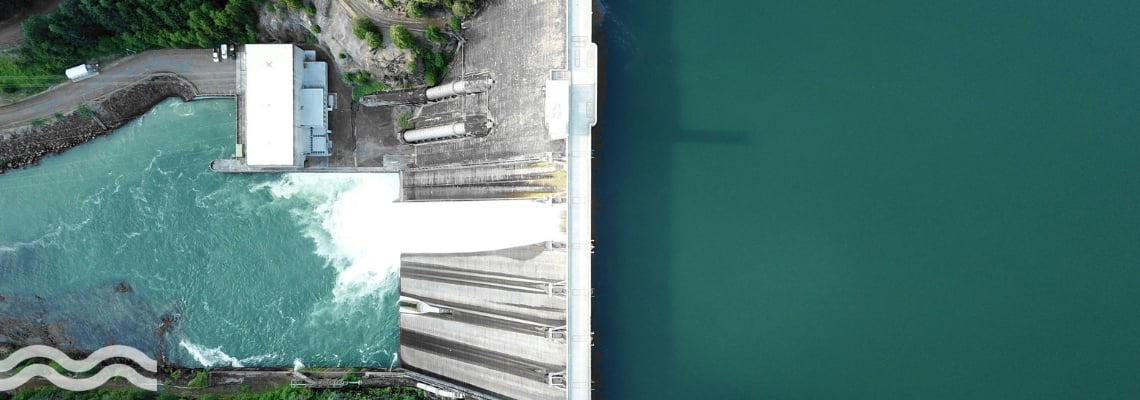
Hydropower plants: How the water-enegy nexus helps us to understand and manage trade-offs

Taking a nexus approach can help to understand the trade-offs that come from certain processes. For example, hydropower output is expected to increase in North America in the coming years, according to a report published in Environmental Research Letters. This comes at a time when the Biden-Harris administration has allocated €386 million for 293 hydroelectric improvement projects across 33 states.
Hydropower plants are a good example of the water-food-energy nexus in action. They provide water storage that can be used for crop irrigation and for urban and residential purposes, and of course, they produce electricity. However, new plants involve flooding of agricultural land and population migration; they also negatively affect eco-systems downstream, right down to coastal areas.
As mentioned above, biofuels have great potential for producing clean energy. However, biofuel crops need a lot of water to grow and energy to harvest. Land used for biofuel crops also takes away from food production.
So, by looking at food, water, and energy production through a nexus lens, it is possible to see potential negative trade-offs as well as benefits and to understand better how to manage them.
Water-Energy Nexus Challenges
Although using water-food-energy nexus thinking has obvious advantages, it is not without its challenges. Collaborative working is not always smooth, and accepting compromises and trade-offs is not always easy.
Putting theory into practice is not always easy and frameworks and regulations are not always aligned. Many projects are in their early stages or still being trialled and so knowledge is fluid and data gathering, management, and sharing may not always work smoothly when many different operatives are in play.
How the water-energy nexus is changing the future of the water industry
The growing challenge for water-food-energy nexus projects is how they are impacted by the growing demands from AI.
First, the positives: the use of AI models has the potential to contribute substantially to finding novel ways of meeting climate, water, carbon and other sustainability goals. Analysis of complex data sets to find patterns that unlock weather forecasting, flood and drought prediction, leak detection, treatment plant and sewer system operation and maintenance, AI has vast potential to provide solutions that span the water-energy-food nexus.
However, as AI data centres begin to hyperscale, the increased energy demands and water usage may stand at odds with the technology's potential for good. Bloomberg News found that since 2022, two-thirds of data centres planned or already built in the USA were in areas already highly water stressed. Meanwhile, the thirst for energy is set to increase significantly; we are already on Chat GPT-4, but the energy required to train its predecessor was enough to light an average home for 120 years. OpenAI has plans to build its data centre capacity of up to 10GW by 2030. Just one gigawatt is equivalent to the output of a large nuclear reactor and can supply 10 million homes.
To meet demands for water and energy, the hyperscale data centres are looking to own their own provision. For example, the xAI factory in Memphis is building an MBR water treatment plant that will supply 49 mg/d to help cool servers.
There are concerns that expected power demand is already outstripping potential supply, which means news sources will be needed. Currently, electricity is produced in coal and gas power stations, with some renewable supplies. To meet demand, nuclear power may be an option, but more likely will be an ever increasing usage of renewable energy. This coupled with circular water practices is likely to reduce the relative demand on the environment. Only the future will tell.
One thing is for sure, if demand for natural resources increases, there will be a need for more progressive water stewardship and water positive practices to help compensate.