Navigating the knowns, the unknowns and everything in between
By: Anna Kummelstedt
How much do we really know about micropollutants? We know that micropollutants are present in our water bodies and that some pose significant risks to public health and the environment. We know they are drawing more attention and concern, and that we now know more than ever. But we also know that our understanding remains incomplete. What we know today is only the tip of the iceberg. The more we investigate, the more we uncover about the scale and complexity of the challenge.
So how do we regulate, monitor and treat something that is constantly evolving, that modern life depends on yet may do as much harm as good, that is often invisible to the naked eye and that we still do not fully understand?
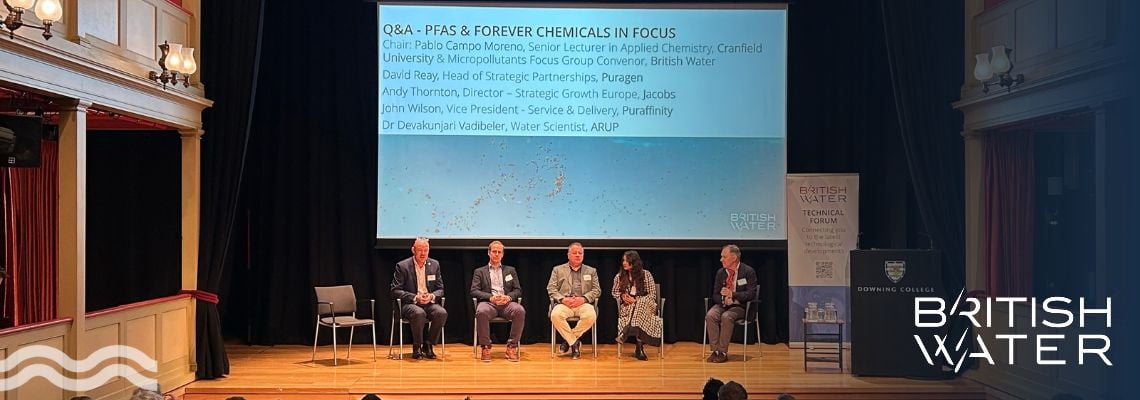
This was the question that shaped British Water’s Micropollutants Conference in Cambridge on 22 September 2026. Opening the day, Robert Bradburne, Chief Scientist at the Environment Agency, delivered a keynote under the title Seeing the Unseen: Our Changing Understanding of Micropollutants. He framed the challenge through the Rumsfeld matrix: the known knowns, the known unknowns, the unknown knowns, and the unknown unknowns.
This matrix provides a useful way of thinking about a problem that is becoming increasingly difficult to understand, let alone solve. Crucially, it points towards the need for an adaptive regulatory model that can respond as scientific understanding, environmental conditions and available technologies change.
Known knowns
Over the years, we have built a substantial evidence base and monitoring programmes around several established pollutants and chemicals. We have a good scientific understanding of their sources, pathways and risks. Metals, mine waste and persistent, bioaccumulative and toxic chemicals sit within this category.
We can regulate, monitor and treat these known knowns. The Stockholm Convention on Persistent Organic Pollutants (POPs), for example, adopted in 2001, agreed to eliminate or restrict POPs such as PBDEs and PFOS. The work of the UK Chemical Investigations Programme trend monitoring project has subsequently demonstrated that source control through product bans and phase-outs of these can work, with clear downward trends in some POP hazardous substances entering our water systems.
That said, known doesn’t mean solved. Many established pollutants will persist in the environment for a long time, and they still require management even as attention turns to the growing list of unknowns.
Known unknowns
What we know we don’t know. Robert Bradburne drew on microplastics and road run-off to illustrate this category. We know they are widespread in water environments and present in substantial quantities. We know they pose risks. What we don’t yet know with sufficient certainty are the cause-and-effect relationships.
These pollutants are highly diverse in size, chemistry, pathways and interactions with the environment. We can see that these pollutants have an impact, but their diversity makes it much harder to establish how. We have very little complete evidence chains explaining their environmental toxicology, cumulative effects or the best interventions.
Another area is contaminant cocktails. We know that substances interact and mix, and that substances can change when they interact with water, but we don’t yet have a good understanding of how they interact, their cumulative effects, such as when microplastics mix with PFAS, or how effective treatment is against the mixture as a whole.
Unknown knowns create uncertainty, which makes regulation less straightforward, particularly where the substances in question also have valuable, practical uses.
However, uncertainty cannot be an excuse for inaction. Nor can we wait for perfect evidence. Instead, we need to ask how we can design systems that let us make decisions and proactively manage risk under uncertainty.
Unknown knowns
Per- and polyfluoroalkyl substances (PFAS) provide a useful example of the unknown knowns: areas we aren’t aware of but understand. We know PFAS are present and we monitor at least some of them. The Environment Agency monitors around 60 PFAS quantitatively, looking for them in biota in about 45 of them. However, that monitoring may capture only around 50% of total PFAS by weight.
PFAS are not a single substance but a whole class of thousands of chemicals. We have substantial knowledge about the class and its presence, but our knowledge remains incomplete, and we may only be capturing part of the problem. We don’t yet have an absolute picture of the full range of PFAS present, or of their behaviour, risks and environmental fate. In other words, the challenge is not simply what we don’t know. It is also the limits of what we think we know.
Unknown unknowns
And lastly, there are the blind spots: emerging contaminants we aren’t currently able to anticipate or fully identify. This is arguably the hardest challenge because it asks us to prepare for what is not yet on the radar.
Antimicrobial resistance (AMR) is an area where significant questions remain, and UK scientists are leading the way in researching the impact of AMR in our environments. Currently, we do not know nor do we know if it significantly matters or what the relative risk to people is.
Establishing early warning systems and broader environmental monitoring is important in this area. The Environment Agency’s Prioritisation Early-Warning System (PEWS) reviews more than 500 chemicals to identify where further science and investigation may be needed.
Innovation also matters for bringing attention to unknowns that could end up becoming tomorrow’s knowns. It applies to technologies too. Innovation funding and supporting pilots could unlock new solutions and approaches to monitoring, treating and removing micropollutants that were previously unknown, changing the available toolbox to respond to emerging risks.
A moving boundary
Taken together, the Rumsfeld matrix shows that boundaries between known and unknown are fluid. In fact, pollutants can straddle the two. As we learn more, new questions emerge. At the same time, the boundary conditions are constantly changing.
Robert Bradburne used the analogy of building sandcastles on shifting sand to explain how regulation needs to be built to adapt to changing scientific understanding, environmental conditions and available technologies: “We have to build the sandcastles. We have to give the industry structure to work with. But we also must recognise that those sandcastles are built of sand and on shifting sand. And those sandcastles will have to be reshaped when the next tide comes”.
Regulation must provide the structure and certainty needed to drive action, providing clarity to the sector on how they must comply, while also providing the investment signal needed to support innovation. At the same time, recognising that regulation, including guidelines and statutory measures, will need to adapt and be reshaped as new evidence emerges and the boundary conditions change.
From single solutions to a multi-barrier approach
The Rumsfeld matrix also tells us there is no singular micropollutant problem to solve, and therefore no one-size-fits-all, universal micropollutant solution. There are thousands of different pollutants, different sources, different, interconnected pathways and different degrees of certainty. It is an evolving, interconnected risk landscape.
Throughout the British Water Micropollutants Conference, technology providers showcased a range of innovative approaches, from Puragen’s activated carbon PFAS filtration solutions, Puraffinity’s approach combining an adsorbent media, granular activated carbon and ion exchange to Purafloc’s liquid activated carbon technology. Other innovations presented included ozone-based technologies from Curio Water, Veolia and Hazen & Sawyer, as well as Anglian Water’s mycofiltration project using mycelium for nutrient and contaminant removal in stormwater and agricultural runoff.
The message at the conference was not that one of these approaches stood out above all and provides the answer. It was almost the opposite. Different contaminants require different interventions and technologies that address one part of the problem may not address another. Ozonation, for instance, can be effective for pharmaceuticals but does not destroy PFAS. Membrane filtration can remove contaminants but can also create concentrated waste streams.
The answer therefore lies in a holistic, multi-barrier approach, combining interventions across the contaminant lifecycle, from source control and monitoring to treatment, residuals management and destruction or disposal.
This means moving away from the search for a silver bullet and towards designing systems in which different technologies solve different parts of the problem.
A multi-barrier approach requires collaboration
A multi-barrier approach cannot be delivered by any one organisation or technology. Collaboration is not a nice-to-have. As the Micropollutants Conference made clear, collaboration is structurally necessary to manage micropollutants across their lifecycle.
The stakeholders in Cambridge were all interdependent. Regulators need scientists to understand which substances are hazardous and to build the evidence base that informs policy and standards. Utilities need technology providers to test and develop solutions, while technology providers need utilities to trial their products and generate real-world performance data. Regulators and industry also need to engage early to understand what regulatory requirements may be coming and what is technically and economically feasible.
The same applies internationally. Contaminants and chemical supply chains do not respect borders, yet countries are at different stages of developing monitoring, regulation and treatment and are pursuing different approaches. Sharing research, data, best practice case studies and lessons from innovations already trialled elsewhere can help avoid duplicating effort and accelerate progress. It's why collaboration with bodies such as the European Chemicals Agency and initiatives like the Global Framework for Chemicals and the newly established UN Intergovernmental Science-Policy Panel on Chemicals, Waste and Pollutions matters. International cooperation can help build a common scientific consensus and a more harmonised approach, crucial for a transboundary issue where inconsistent standards can limit the impact of individual efforts.
Data is the foundation
Collaboration also matters because of data-sharing. Data underpins scientific understanding, informs policy and standards, allows technologies to be tested and provides the evidence needed to measure progress.
Collecting good data means investing not only in treatment technologies, but also in laboratory capacity, analytical methods, real-time monitoring and modelling, as well as bench and pilot testing, and making the resulting data accessible and useful.
The value of this investment is evident in PFAS monitoring. Marcus Rink, Chief Inspector of Drinking Water Inspectorate (DWI), spoke at the Conference about how, over the last three years, DWI has generated 2 million data points across 2,546 abstraction points. This has helped identify just under 10,000 detections above the detection limit and prioritise 82 abstraction points across 11 water companies for improvement. This example demonstrates how data can directly inform regulatory action, in this case supporting DWI’s precautionary risk-based strategy by identifying where intervention is needed and driving targeted improvement programmes.
In terms of the Rumsfeld matrix, robust data moves questions from the unknown towards the known, supporting faster, more targeted interventions. We cannot regulate what we cannot measure. We cannot treat efficiently what we cannot adequately characterise. And we cannot invest confidently if we cannot anticipate how requirements may change.
Conclusion
The Rumsfeld matrix offers a way of understanding the micropollutant challenge, but perhaps its main takeaway is that the boundaries between the known and unknown are constantly moving.
We know more than ever about micropollutants and their management, yet significant unknowns remain. There is no one-size-fits-all fix. And a holistic, multi-barrier approach underpinned by collaboration is fundamental.
Yesterday’s priorities cannot be the limit of tomorrow’s response because today’s unknown can become tomorrow’s known problem; we need to build our sandcastles for today while being ready to reshape them when the tide comes in.
Share your water story with us
Share your water technology stories with us
Do you have an innovation, research results or an other interesting topic you would like to share with the international water technology industry? The Aquatech website and social media channels are a great platform to showcase your stories!
Please contact our Sr Brand Marketing Manager Annelie Koomen.
Are you an Aquatech exhibitor?
Make sure you add your latest press releases to your Company Profile in the Exhibitor Portal for free exposure.