Can the excess heat issue solve the data centre problem?
Data centres and water… If ever there was a water issue taking over the consciousness of the world right now, this would be it. If only data centre water use were a straightforward question, with an easy-to-verify answer, but it isn’t, and there isn’t.
One thing is clear: data centres are not going away; in fact, they are being built at an astonishing rate. And while much of the current focus has been on water usage, other environmental concerns are also being raised as the number of facilities increases and as the size and scale of the centres continue to grow to meet the demands of our AI-hungry age.
One concern is the heat being generated from the ‘always-on’ servers and racks of processors. A recent Bloomberg report suggested a four-degree rise in downwind temperatures.
But what if that excess heat generation could be used to turn the story of data centres and water upside down? This is what a partnership between Bengaluru-based startup Uravu Labs and Imagine H2O Asia is hoping to achieve.
It's getting hot in here
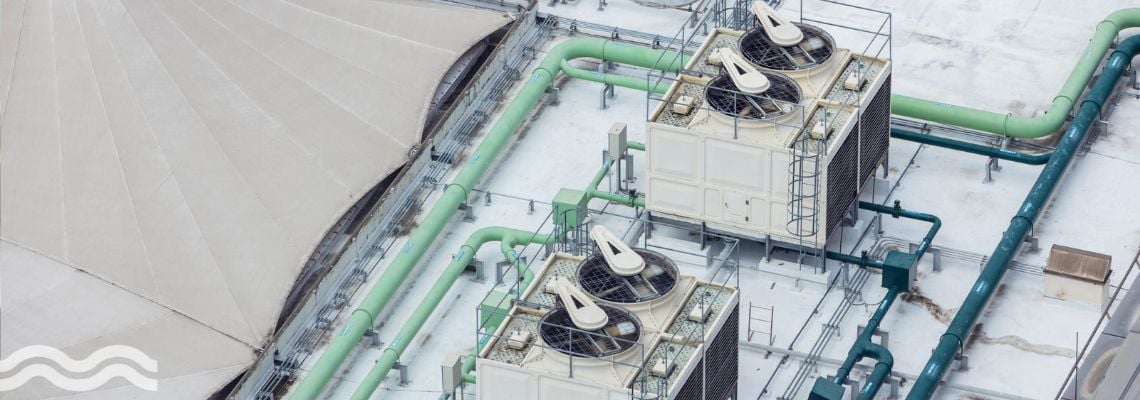
Let’s take one ‘problem’ at a time. According to Uravu Labs’ own calculations, data centres ‘reject enormous quantities of low-grade heat (30–60°C) to the environment’.
Where does this heat come from? Mostly, it comes from the energy used to power the servers and processors that increasingly run every aspect of our world, and the heat generated from the immense computational power involved.
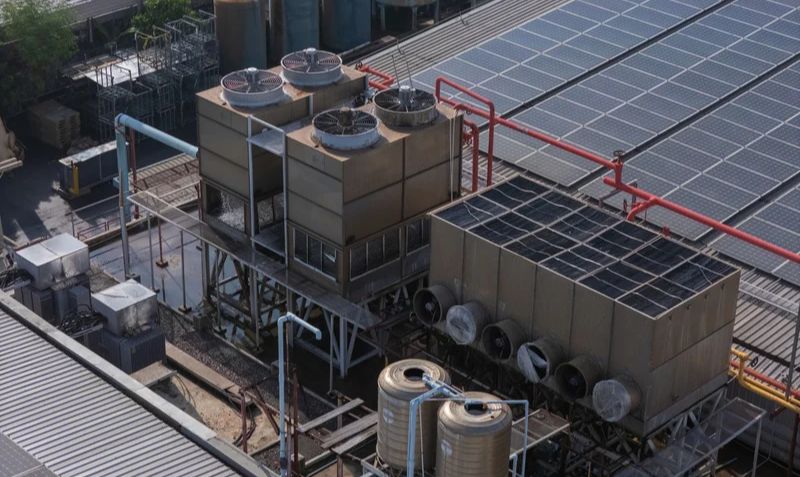
According to McKinsey, total global data centre power demand could reach 35-40 GW by decade's end, with AI workloads accounting for 25-30 per cent of new capacity additions. In 2025, data centres consumed 1.5 per cent of global electricity production; by 2030 this is expected to rise to 4 per cent.
All that electrical power becomes thermal energy; according to the Bloomberg report, a data centre using 50MW of electricity will generate the same heat as 54,000 homes.
CNN reported that data centres are creating ‘heat islands’ in their local neighbourhoods, quoting researchers who found ‘surface temperatures increased by an average of 3.6 degrees Fahrenheit after a data centre started operations. In extreme cases, nearby temperatures increase by up to 16.4 degrees Fahrenheit.’ This increased warming was reported in the vicinity of data centre hubs in Mexico’s Bajio region and Aragon, Spain, but also extended as far as six miles from the sites.
Not as thirsty as they used to be
It is possible to read 10 papers or reports on how much water is used by an average data centre and come away with 10 different answers. Do opponents overestimate water consumption, or are data centre operators not sharing the full picture? There is the question of whether you include supply chain water use, such as in semiconductor manufacturing, and the almost exponential increase in demand for more processing power.
As we have seen, the energy needed to power data centres is increasing, and by 2030 could represent four per cent of total global energy use, a 2.5-fold increase in the space of 3 years. Depending on the type of energy being used, this could have a big impact on local water use, increasing competition in areas that are often already water stressed.
In an article on its website, Uravu Labs’ CEO Swapnil Shrivastav and the company’s Senior Scientist Dr Rishabh Srivastava point out that 60 per cent of data centre capacity through 2030 is located in regions classified as water-stressed by the World Resources Institute. “This creates regulatory risk, community opposition, and potential operational constraints,” they add, citing more than one billion gallons of water consumed globally every year by data centres – a figure that could rise by as much as 30 per cent a year.
With changes in how modern data centres are cooled, the volume of water used within the facilities has decreased. Direct-to-chip and closed-loop cooling systems reduce water consumption dramatically compared to evaporative cooling towers, but there is a trade-off because they increase energy requirements.
And as Shrivastav and Srivastava point out, every method of cooling data centres, whether water-intensive or not, treats generated heat as a waste product.
Writing on his LinkedIn profile, Shrivastav, points out the dilemma:
“Air/dry cooling = no water, but the chillers burn extra electricity and stress the grid. And every kilowatt of that compressor power becomes more waste heat dumped locally,” he said. Before adding: “Evaporative cooling = far less electricity, but it drinks water and pushes humidity into the local air. So, water-stressed regions are backing away from it.”
He points out that you either ‘vent and stress the grid, or evaporate and stress the watershed. Two ways to pay.”
But what if that excess heat could be put to good use?
Using excess heat to create and save water
In London, Aecom is developing a heat network that has the potential to channel that excess heat into offices and homes. This concept is established in other industries; for example, the Port of Rotterdam channels excess heat from its industrial users into commercial and residential properties.
This addresses the problem of excess heat, but what about water?
Uravu Labs is partnering with Imagine H2O Asia to turn the wasted heat and water conversation on its head, using Atmospheric Water Generation (AWG).
Specifically, the Uravu Labs approach uses a sorbent-based AWG approach to turn waste heat from data centre servers into distilled water for cooling, reducing freshwater use while keeping cooling energy demand low.
Imagine H2O Asia is facilitating the roll-out of this technology in data centre operations across the Asia-Pacific region. If the pilots are successful, it will prove that waste heat can be reused directly on site to produce water for cooling data centres.
Heat reuse: the way forward as data centres cluster and hyperscale
Uravu Labs uses a proprietary liquid-desiccant system that extracts water from ambient air. It does this using the following steps:
Absorption: Ambient air passes through a proprietary liquid desiccant solution that captures water vapour with extremely high efficiency across humidity ranges (20-90% RH)
Heat integration: Diluted desiccant is heated using 30-60°C waste heat from data centre cooling loops. This heat would normally be rejected via cooling towers, dry coolers or chillers and be expelled into the surrounding atmosphere, causing the problems mentioned earlier.
Desorption: Under a controlled partial vacuum, water is separated from the desiccant, condensed, and purified to drinking water standards.
Regeneration: Concentrated desiccant returns to the absorption cycle, creating a closed loop.
Cooling integration: The desorption process requires heat to drive evaporation and generate water vapour. Data centre waste heat provides the energy while simultaneously being cooled, reducing the demand on chillers.
Essentially, a problem (waste heat) has become a solution to both itself (heat released to the atmosphere) and another problem (water use).
What will the pilots be testing?
The compact system is designed to be modular and scalable. It can be deployed in either 20- or 40-ft shipping containers; integration requires a heat exchanger and a compact piping loop.
Aquatech spoke to Uravu Labs’ Ridhima Singh to find out more about the pilots:
Why is water loss an issue for data centres?
“The extent of water loss is determined by the cooling technology deployed,” Ridhima says. “Facilities using cooling towers typically record a water usage effectiveness (WUE) of approximately 2.5 litres per kWh, indicating that 2.5 litres of water are consumed and lost to the environment through evaporation, for every kWh of data centre load cooled.”
She continues: “Adiabatic coolers, owing to their hybrid mode of operation, can reduce this figure to as low as 0.25 litres per kWh. Air-cooled chillers consume no water on site; however, their higher power demand may result in indirect water consumption, depending on the grid's generation mix.”
How will Uravu Labs address this issue?
“Uravu's role is two-fold,” she begins. “A) it uses the waste heat to supply water for adiabatic coolers, reducing the volume drawn from the grid, and b) it offloads a portion of the facility's heat load, thereby reducing overall energy consumption of downstream coolers and chillers.”
How much clean water can the unit produce on average?
“Output depends on how much heat is available to the system. Uravu's smallest unit, which can draw around 125 kW of heat, produces up to 2,000 litres per day, while the largest 1 MW unit can produce up to 30,000 litres per day,” Ridhima explains.
“Actual production is driven by the rate at which the system absorbs moisture, which in turn depends on local weather. The system operates in temperatures from -10°C to 50°C and relative humidity from 23 to 99 per cent, and needs a heat source of at least 40°C.”
She adds: “The collaboration is intended to explore pilot opportunities, and we don't have specific water targets for the same, but we are targeting pilots from 2000-10,000 litres per day capacity.”
Initially, how many data centres will the unit be installed in?
“Our 125 kW (2000 LPD) units are already tested and entering production,” Ridhima says. “A 350 kW (10k LPD) working unit for data centre installation is targeted for testing in Q2 of 2027. We are targeting at least three sites by Q3 of 2027.”
Should AWG be embedded in every data centre hub
Rather than rely on groundwater, where competition for resources is likely to increase in the coming years, could data centre operators turn to AWG as an alternative provision?
Proponents of AWG technologies focus on the fact that the atmosphere holds six times more water than every river on Earth combined and that this ‘resource’ is replenished naturally every 8-10 days. Potentially, therefore, sorbent-based AWG that uses the waste heat from data centres to produce water for cooling could reduce two problems at once.
Share your water story with us
Share your water technology stories with us
Do you have an innovation, research results or an other interesting topic you would like to share with the international water technology industry? The Aquatech website and social media channels are a great platform to showcase your stories!
Please contact our Sr Brand Marketing Manager Annelie Koomen.
Are you an Aquatech exhibitor?
Make sure you add your latest press releases to your Company Profile in the Exhibitor Portal for free exposure.