
20,000 leagues under the sea: Why the latest desalination investments are looking to the bottom of the ocean
Desalination, the process of taking the salt out of seawater to produce drinking water, has been around for many decades.
Since the first large-scale project was built in 1930 in Aruba, over 20,000 plants have begun operating around the world. Desalination has become a proven way to help diversify water supply in nations grappling with water scarcity.
Process innovations over the years have addressed areas like membrane efficiencies, energy recovery and brine harvesting. Yet a new group of companies is looking to disrupt the conventional, land-based way of desalting water.
Rather than occupying land with huge infrastructure plants located near the sea, these latest companies are instead taking things to an entirely new location to rethink desalination: the bottom of the ocean.
Known as subsea desalination, the developments intend to build modular desalination plants across the seabed. The ambition is that this takes advantage of abundant space and harnesses the natural pressures deep underwater to optimise what is still seen as a more energy-intensive water production process.
Currently, it’s a three-way race between two Norwegian companies and one from the US to prove out large-scale, sub-sea desalination.
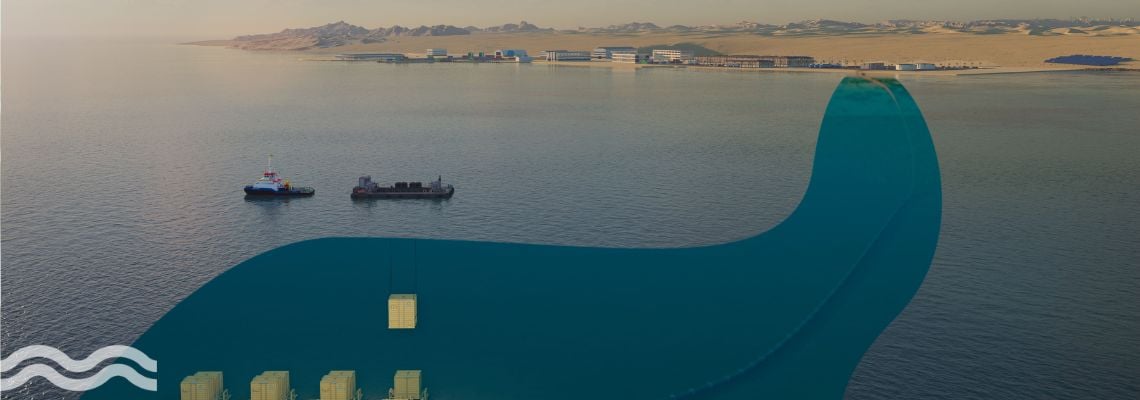
Developing the next generation of desalination infrastructure
Norwegian subsea company, Flocean, recently extended its Series A round of investment to €25.5 million.
The organisation claims its seabed solution can lead to a 50 percent reduction in energy consumption, 95 percent less coastal land use, and also “no toxic brine discharge”.
Additional funding was provided by Water Unite Impact, managed by Wellers Impact, which follows other strategic investors including Xylem, Burnt Island Ventures, Freebird Capital, Katapult Ocean and Nysnø Climate Investments.
The round enables Flocean to complete and deploy Flocean One, which it is calling the world’s first demonstrator and commercial subsea desalination plant, scheduled to begin full-scale operations in 2026 at Mongstad, Norway.
Speaking to Aquatech Online, Alexander Fuglesang, Founder & CEO of Flocean, said: “Global demand for freshwater is accelerating far beyond what traditional desalination can deliver. Meeting the scale of this challenge requires going subsea, and this new funding—along with a strategic partnership with Xylem—enables us to move faster and serve both nations and major industrial customers seeking more efficient, reliable water sources.
"We continue to test at Norway's largest industrial supply base. These trials are helping us scale our capabilities to bring deep-ocean drinking water to more coastal communities."

Seafloor desalination farms
Meanwhile, US-based water-tech company OceanWell also has its sights set on scaling sub-sea desalination. Last year, it secured €10.5 million in Series A funding to help scale its modular deep-sea reverse osmosis desalination solution.
The company estimates that each pod can produce up to one million gallons (3785 m3/day) of fresh water daily, removing salts, bacteria, viruses, pesticides, and PFAS to produce 'ultra-clean' water.
A modular approach means that each project can be scaled according to the capacity requirements and is built to withstand the rigours of a deep-sea environmental operation, OceanWell said.
The company's first farm is being developed in California, USA, where the company is based, and is expected to produce 220,000 m3/day of fresh water.
Deep-sea desalination to quench mining’s thirst
A third company in the running is Waterise, also from Norway. It recently announced it would be supplying water to the Jordan Phosphates Mines Company with a deep-sea desalination project in the Gulf of Aqaba.
Waterise claims it uses 30-40 percent less energy than conventional desalination, using a system that comprises 50,000 m3/day capacity modules located 400 meters below the surface.
An early pilot project in Boknafjorden, Norway, has reportedly demonstrated a 40 percent reduction in energy compared to conventional reverse osmosis (RO) technologies.
.jpg?h=628&iar=0&w=1200)
.jpg?h=628&iar=0&w=1200)
.jpg?h=628&iar=0&w=1200)
