Viewpoint: People at the heart of the digital age
There is a saying about the water industry that things happen slowly. This is not always true. Like many industries, water companies and tech entrepreneurs are embracing digital tools and artificial intelligence, embedding them in everyday processes to drive efficiencies, reveal fresh insights and solve problems across the sector, from wastewater processes to purification, and from predicting weather events to watershed restoration and much, much more. Driven as much by regulations, such as the EU Action Plan on the Digitalisation of the Water Sector, as by economic needs, this digital adoption is only going to gather pace.
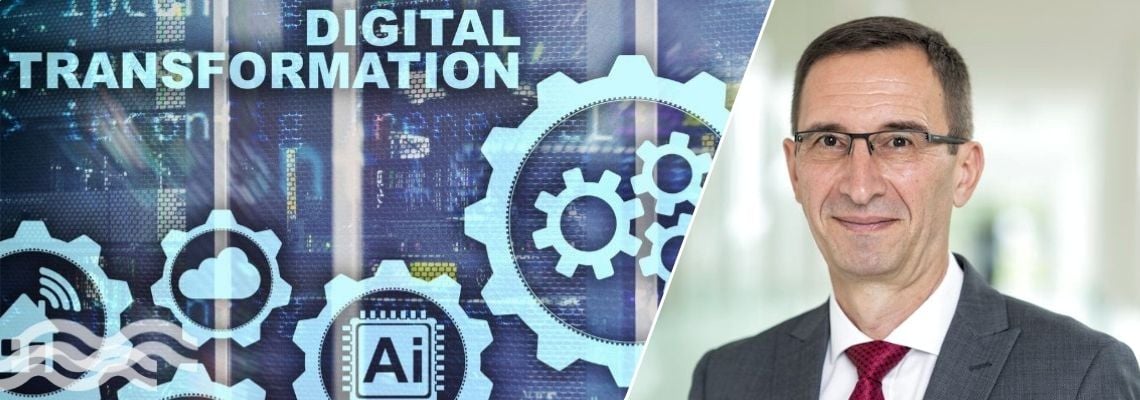
Aquatech Online talks to Dragan Savić, Global Water and AI Strategist at KWR Water Research Institute, to find out whether the water sector is making the most of digital tools and technologies, and to explore the challenges and opportunities.
Are we currently utilising digital tools correctly?
Well, I think the first point I'd like to make is that AI is just another tool. It's a powerful tool, but we shouldn't forget that. If I have to make it really simple, it's just another Excel spreadsheet. Obviously, it can be much more powerful than that.
Well, I think the first point I'd like to make is that AI is just another tool. It's a powerful tool, but we shouldn't forget that. If I have to make it really simple, it's just another Excel spreadsheet. Obviously, it can be much more powerful than that.
We also need to consider how prepared the industry is for it. Because, quite often, we have this ‘tech will fix it’ mindset. That tech will sort everything out, whereas people are still the key components across every part of the water sector. The people in the industry are those who do the hard work, the hard graft.
There is no silver bullet with AI. That would be my key point. But there are some very exciting opportunities.
And digital technology is just another tool in the toolbox. There is no silver bullet with AI. That would be my key point. But there are some very exciting opportunities. There are lots of people leaving the industry, resulting in a loss of expertise and experience. And that's where AI can help, by encapsulating some of that expertise through these systems. I'm very excited about the learning ability of AI. That's what we can capitalise on. And it can engage a younger, AI-literate workforce.
What does the rise of AI and digital solutions mean for the water workforce?
We need to have strong support from the people on the ground. Applications of AI require a very clear diagnosis of what you're doing, rather than ‘this is the solution, what is the problem?’
And that's what I see quite often. And that’s not just with AI, it's with quite a lot of other tools, digital tools in particular. That also applies to some treatment technologies. Lots of things need to align for technologies to make a positive impact on the water sector.
People on the ground are the key. They need to be part of the diagnosis, part of the discussions about how we solve problems and use technology. But if they're not trained to work with these tools, then we don't have a hope.
So, the workforce needs to be part of the conversation regarding digital tools?
We need training for people. They need to understand the basics of AI and the tools that they're being offered or given. The other thing is we always need to keep that human in the loop. That's my starting point.
And I see danger, particularly if the push for a particular tool or technology comes only from the top down. Where somebody decides that we're going to move in this direction, and you guys have to grin and bear it. Whereas I think it has to be both ways. It has to be required or requested bottom up.
We need training for people. They need to understand the basics of AI and the tools that they're being offered or given.
For example, ‘we have a problem, we have to sort the leakage issue’, or we have to sort the CSO spills issue, or pollution, or flooding. Of course, if I'm the person responsible for a particular area or challenge, I'd like to have something in my toolbox that will help me. But support from high above is extremely important because we've seen in the past that sometimes you have very enthusiastic technologists who want to do something about a problem, but there is no funding or push across the organisation.
What areas would benefit from using more digital technology?
We're talking augmented intelligence rather than just artificial intelligence. And the beauty of some of the latest tools is that you can actually speak to the AI rather than pouring numbers into it, or trying to do all sorts of things. You can speak to it and tell it, ‘I don't think you have explained that to me, or why are you suggesting I make that kind of decision in my network?’
One particular area that will benefit, both for short-term management and operations management, for example, is gaining a better understanding of the weather and the impact on performance, for example, what can you do in preparation, before a weather event happens?
We're talking augmented intelligence rather than just artificial intelligence.
Digital tools and AI will also help us prepare for emergencies, for example, if something happens in the system and we need to act quickly. For very long and strategic decisions, consider how you ingest all the information, for example, about future expansion or future maintenance of the system, where we don't know what is going to happen with the climate, or when we don't know what is going to happen with people's movement.
The number of people moving to Europe from the Mediterranean region must have changed the demand for services, everything from energy, telecoms and water. And in the Western world, we are ageing rapidly. So, how do we provide the services to the largely elderly population? Because their demands are different.
And we have this deep uncertainty about the climate: is it going to change by one degree, five degrees? What happens if the frequency and magnitude of events, such as freeze-ups that cause pipe breakages, become greater? The deterioration of our systems in the future is going to be different.
Looking into future scenarios and strategic decision-making will be important areas because humans are not very good at predicting the future. What I do like, for example, is the UK government’s latest water policy paper, because it talks about regulation over 25-30 years, rather than for just five-year periods.
Data gathering and processing will be even more important moving forward, but do we know what we need or what we are missing? Do we have too little or too much, and what do we do with the data we get?
We are getting more and more data. Utilities, for example, are rapidly moving to the widespread use of smart sensors. But the point I always try to make is that we have to make decisions now. So, I don't take the argument that ‘we don't have enough data to make decisions, so we'll wait’. No, you can make those decisions that are important now, those no-regret decisions, and then collect more data. And then when that future happens, then you'll have a better idea of what the next step needs to be.
I always say, think about what data you are really missing. Can you infer that type of data from something else? I'll give you an example. Before COVID, you would shower in the morning, get in a car or travel on public transport, go to work, use the toilet there, drink water, and everything else. During COVID, the patterns changed. Now, you did all that at home. Demand shifted in space and possibly in time, but we didn’t have that data.
When that future happens, then you'll have a better idea of what the next step needs to be.
What we did was to look into mobile phone data (being careful of GDPR and privacy). You look into those cell towers and how many people are within their coverage, over certain periods of time. You then get a better idea of spatial distribution; you don't measure the demand itself, for example, but you get an idea in real time from your phones.
Another example: rainfall. People were using those smart wipers. And if they are working, you know it's raining in that part of the city. Or they were using CCTV cameras and clever AI to extract photographs, from which they could determine the intensity of the rainfall.
I mean, that's still technology that hasn't been deployed on a mass scale, but you can see how quickly things can move because cars now use online AI to detect obstacles, and that works really well.
What are some of the dangers involved in the increased use of digital tools in the water industry?
Well, the general danger is that these data centres that we now rely on, now that everything is in the cloud, have a huge environmental impact: both water and energy and depending on the local situation, it could be quite detrimental to the environment in the area. Although it should be noted that the organisations that run them are taking steps to reduce that impact. But I think that's a big thing.
Cybersecurity is another one, because there are quite a lot of concerns about privacy and data that shouldn't be going into the general cloud. Rather, it should be stored on local clouds or servers. That's one of the things that quite a lot of companies are looking into.
There are quite a lot of concerns about privacy and data that shouldn't be going into the general cloud.
Providers have to be cognizant of the environment they're working in. Lots of them go with one of the big providers. I think we need to have something cross-platform. I'm very much in favour of open science and open platforms. Those that you can run in the local environment. Not just for testing, but also for implementation. You have to think, is it more beneficial for the organisation to go to this big provider, which has really good cybersecurity and redundancy in the system, or do you want to go local, but then you have to provide some of those services yourself?
So, you have to be very careful and vigilant about the security of the systems you are using to produce and store data.