Supporting utilities capital planning through hydraulic modelling
Aquatech has been sharing water stories that matter since the 1960s. These cover challenges and opportunities, thought leadership and opinion, vital technologies and the latest innovations across the core Aquatech exhibition markets. Just like the events, our newsletter shares the stories of the people, places and products shaping the world of water.
We have introduced a new series, where we will be sharing the stories of some of the rising and shining stars working across the sector, focusing on how they first started in the industry, what roles they play, and how they see the world of water changing over the course of the next few years.
In this first article, Aquatech meets Naisargi Dave, a hydraulic modeller based in Nebraska, USA.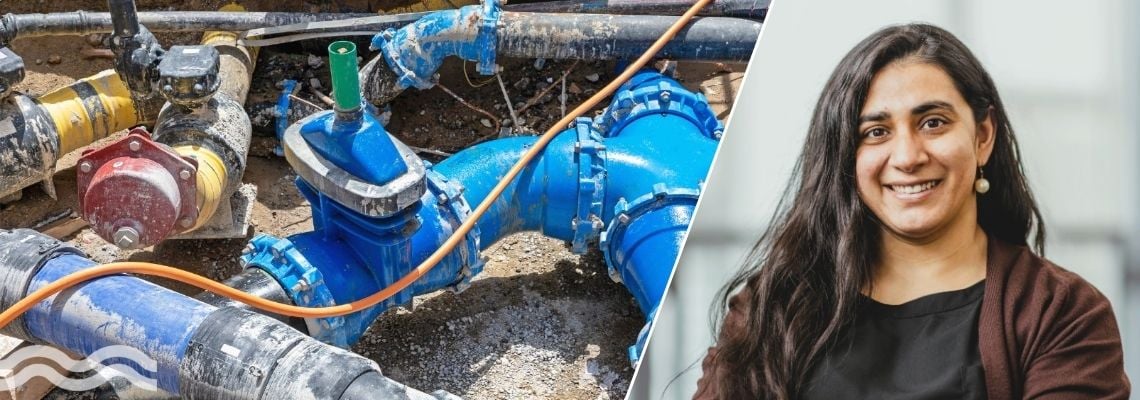
Describe your current role?
I work for HDR, an engineering firm with offices located in countries all over the world. As a company, we work across many sectors. My role, primarily, is modelling and planning for utilities, specifically in drinking water and wastewater, which can also include stormwater.
Generally, the modelling and planning support utilities’ capital planning for improvements to existing infrastructure. It also involves planning for future scenarios, ranging from new developments to general condition-related improvements to the infrastructure, such as whether something needs to be replaced.
What tools do you use for hydraulic modelling in those scenarios?
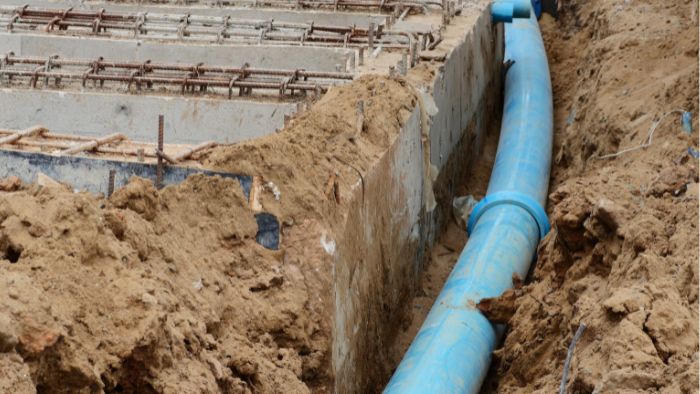
Hydraulic modelling, you could say, is one of the oldest versions of what we now call digital twins. In hydraulic modelling, we take either the full system or part of the system, and digitise it, along with relevant parameters such as pipe sizes, pump capacities, and all of the different variables in a typical water distribution system or a sewer collection system.
Once we have added all of those different parameters, we run the model and validate it by comparing model results with actual field-observed data. Once validated, we can run ‘what-if’ scenarios. For example, what if the demand expands to a certain percentage of current capacity or what would happen if a particular pump went out of service? We run scenarios for different possibilities.
In some ways, digital twins are a newer, more advanced scenario planner than hydraulic models, a more dynamic version, which allows you to feed live data. Hydraulic modelling is a more static, statistical prediction tool.
How do you adapt to changing climate conditions?
The conditions we are living in are rapidly changing, and the infrastructure that is currently in place was not designed or built for this level of change. Utilities are realising that they are also going to be vastly different in the future than they are currently.
The impacts of that change will happen in the same communities they live in and the same communities they serve. With that understanding, everything we model will have to account for climate change.
We are often modelling the ‘what-if’ scenarios for more intense storm events, and a lack of water supply sources. The results of these directly help them understand the level of impact these critical events can have on their systems and can thus proactively plan for them. Adaptation is often a combination of infrastructure investments, management strategies, and strategic communication for community outreach.
How is your work affected by changing regulations?
Utilities are unique in the way that they must meet government regulations while keeping their community’s best interests in mind and operating a large complex network of physical infrastructure. When regulations change, the threshold for what is ‘acceptable’ also changes. We often find that when regulations get stricter, we have to start using more of those critical ‘what-if’ scenarios and include more robust recommendations.
In addition to being a modeller, I also support infrastructure planning efforts, and we often find ourselves changing management strategies and securing funding sources as a priority when accounting for changing regulations.
How is your role changing?
Obviously, every scenario is different, every project is different, and although I haven't been a modeller for very long, I am learning that things are changing. For example, the software that I used when I started learning modelling is no longer used, and this is the case for other software as well.
The prime reason for this is not necessarily software-related, but we are starting to see that we need more and more capability in our work. We're starting to see more and more data coming in that we need to account for.
At a very fundamental level, you could still solve an equation with a pen and paper
At a very fundamental level, you could still solve an equation with a pen and paper. But because we are now starting to take into account all these different things that affect a system, a distribution system or a collection system, we're starting to see that we need more and more capability in our models. We need more from our software. We need to gain more insights for the utilities.
We're still, in a way, doing the same thing, but with way more information than we used to in the past.
What new information are you seeing?
As an example, we now have live meter data, which is a fairly common trend in the industry; people are now using sensors, meter loggers, pressure loggers, you name it. It has become common, and it lets people see how their system is responding dynamically.
Previously, we could model from a snapshot in time, whereas now we have a much larger data set. For example, when modelling a pump in the past, we could focus on one specific point, a certain flow, or a certain pressure. Now, we can see how demands change throughout the day and how the system responds dynamically. With more data, we can also be more accurate with our modelling.
What led you to a career in hydraulic modelling?
Going all the way back, I grew up in India, which is typically known for being a very water-scarce country. Growing up, we often had water issues, such as supply and availability. There was also a quality issue that we never questioned because it was more natural to me. In every single household, you would see a personal water filter for drinking. You couldn't drink the tap water. It wasn’t something that was made specific; it was just known, passed down from one generation to the next, that you couldn’t drink from the tap water.
Similarly, on the supply side, every house had a water tank on the roof. And it was just natural to us that we could only fill our tanks twice a day, two hours in the morning or evening, and that's about all the water you get. So, by default, you have a quota you can use; if you run out, you would need to go to the market to buy some more, or pay for a tanker to visit your house.
I drank from the tap, and didn’t die! To me, that was mind-blowing. I was so fascinated by that
I never questioned this until I went to college in Germany for a summer program. I had always heard that in Europe, you can drink tap water or from fountains. And I thought, that can't be right, but I went there, and people did it, and I drank from the tap, and didn’t die! To me, that was mind-blowing. I was so fascinated by that. But also, I was curious about whether you truly always need that much water. Where do we strike the right balance?
At that point, I decided I wanted to work in the water sector. At the time, I didn't really know that I wanted to work with the utilities. I just wanted to work in water, and because I was young, I was looking at everything from a more holistic perspective.
And then from that point, it was more like a stepping stone. I did civil engineering, and at the time, I was more focused on the environment and natural resources. At grad school in the US, I got a master’s degree in environmental engineering and, from there, worked on conserving water in agriculture.
I thought that if we can save water in one sector, then we can have more in another – a water accounting perspective. From here, the next step was to focus on environmental engineering, but my heart was still on drinking water and wastewater work.
All my life, I have loved working with numbers and enjoyed data analysis, which made me realise that perhaps a path aligned to data and modelling would be a better fit for me. Those stepping stones led to where I am today.
Where do you see your career path taking you?
There are a couple of things I see as important: first, the availability of water itself. I think water conservation is going to be more important than ever; the number one most important thing in the water sector moving forward. You could attribute that to many different things, for example, climate change, but also the quality of water. We often start with quantity, but if the available water is contaminated, then it’s not much of use.
Second, we need to make more progress on digital transformation. Traditionally, utilities have not been that advanced in adopting digital tools, and that is primarily not because they are averse, but because the nature of the work is so physical.
I think that's going to be one of the most important things in the industry
If you really narrow it down to what utilities actually do, it's a simple goal: source water, clean it up, and get it to residents. And then for wastewater, it's also a very simple goal: take wastewater from homes and buildings, treat it, and either reuse it or release it back to where it came from.
The core nature of this is very physical. It all depends on the pipes, the pumps, and the treatment systems. So, I don't personally believe utilities are averse to adopting digital tools; it’s just that the physical aspect of their work often takes priority, including emergencies related to infrastructure failure.
However, with the digital transformation, we have this opportunity to detect things faster, plan better, and prevent some of those emergencies from happening. And I think that's going to be one of the most important things in the industry.

.jpg?h=628&iar=0&w=1200)