Viewpoint: From adaptive water management to urban water resilience
Smart cities as a concept are gaining traction as we turn to technology and data to drive efficiencies and to address economic, social and environmental challenges. While some may view a smart city as one dominated by new technologies, and others might envisage a futuristic urban metropolis more at home in a science fiction film, in reality, it is more about finding ways of using and adapting tech and data to make the complex network of public services work more effectively, making better use of the resources we have.
Water is a natural beneficiary of smart cities. It is a precious resource that is easy to waste, hard to move, and expensive to treat. With improved sensors and better data, it is possible to make cities more water resilient. However, we are still in the early stages of creating truly smart water cities.
In this viewpoint, Shirley Ben-Dak, Senior Advisor at SWAN (the Smart Water Networks Forum), shares her thoughts on how smart water management approaches will evolve to strengthen urban water resilience, offering insights from existing projects.
How important are data-driven observations in strengthening urban water resilience, and how are they currently being used in practice?
“Data-driven observation is no longer a ‘nice to have’ for urban water systems, but rather a foundational part of resilience-based strategies across regions. It also directly relates to public accountability. You cannot adapt to what you cannot see, and the consequences of inaction can lead to really tragic headlines dominated by loss of lives, crumbling infrastructure (including mission-critical institutions), severe business losses, etc.
“For too long, utilities have operated networks largely invisible below the ground. Smart water networks change this dynamic by layering sensing, communications, analytics, and decision support on top of physical infrastructure, enabling operators and city managers alike to have a continuous, near/real-time picture of how the system is actually performing, and being able to run multiple simulations and forecasts.
The common thread here signifies a shift from periodic snapshots to continuous situational awareness
“In practice, this is already delivering measurable resilience gains. For example, in water-stressed Arizona, Scottsdale Water, a utility serving 240,000+ people through more than 2,100 miles of pipeline drawing mostly on the Colorado River water supply, deployed FIDO AI to support acoustic leak detection efforts, uncovering active leaks it had previously been unaware of, including below a major roadway in a busy commercial district.
“The same pattern holds across geographies and use cases. Smart metering is a prime example of this from an urban management perspective, transforming customer-side visibility, enabling utilities (and sometimes) customers themselves to detect leaks, understand demand patterns and irregularities, and engage customers in conservation efforts and more targeted customer service. And on the wastewater and stormwater side, Finland-based Fluidit, which provides real-time monitoring paired with hydraulic models, is helping cities anticipate overflow events rather than simply reporting them.
The common thread here signifies a shift from periodic snapshots to continuous situational awareness – this is essential for urban water systems to more properly address climate stresses, deteriorating assets, and growing demand.
How is AI being applied to make sense of fragmented urban water data?
“Urban water data is inherently fragmented, with SCADA, GIS, customer information systems, work orders, meter data, and other external sources, such as weather feeds, operating often across different silos, frequently with inconsistent formats and quality. In my opinion, one of AI's most valuable roles today is to act as a synthesis layer, essentially supporting efforts to clean data processes, align data with interoperable measures, validate sensor and data quality, and signal when fragmentation occurs, but at speed and scale.
“Some common use cases we have seen throughout the SWAN network include anomaly detection, AI-assisted asset condition assessment and failure prediction, such as in the case of pump performance-related optimisation efforts launched by StormHarvester at Southern Water (UK), energy and chemical dosing optimisation in treatment, demand forecasting, and more recently, leveraging natural-language interfaces that democratise access to institutional knowledge through faster query-answer scenarios.
Overall, trusting AI as a force multiplier can be challenging
“Overall, trusting AI as a force multiplier can be challenging, and this stems from two layers. The first is the data quality itself: sensor drift, interval gaps, mislabelled assets, and inaccurate GIS records can all lead to AI potentially confidently producing wrong answers from poor inputs. Utilities equipped with data governance, validation pipelines, and accepted metadata practices can help reduce some of this uncertainty.
“The second is how we approach the AI-trust dynamic organisationally. The AI deployments that succeed/will succeed are those that keep humans in the loop, explain their reasoning, consistently refine models and outputs, and build internal credibility through verified wins. These are just some of the critical topics covered across SWAN's AI Community of Practice discussions with utilities, technology providers, engineering and consultancy firms, and ecosystem partners.”
How do we move from reactive repairs to more anticipatory, adaptive approaches?
“Visibility, modelling capabilities/behaviours, and organisational readiness are all part of these efforts, working in concert and based on each entity’s starting point, drivers (internally and externally), as well as their future organisational strategies. Reactive responses are not carried out in isolation, but are actually indicative processes worthy of revisiting to be able to drive efficiencies.
“Some type of visibility often comes first. A utility cannot anticipate failures in assets it isn't monitoring. The foundational investments of sensing (i.e. some type of smart data collection), smart metering, GIS, communications infrastructure, and integrated data platforms are what SWAN describes as the early layers of the Smart Water Journey, and they are prerequisites for everything else. Most of the utilities in SWAN’s global case study library started their digital transformation efforts by instrumenting their networks and prioritising data management seriously.
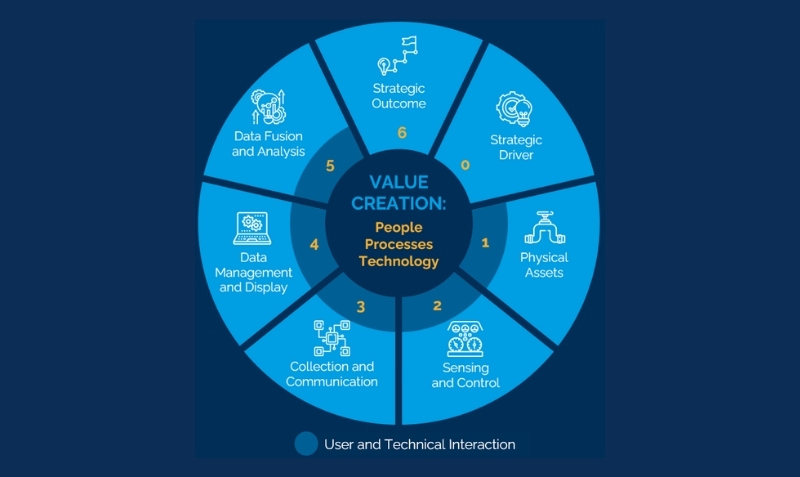
The SWAN Circular Framework: The Smart Water Journey”, The SWAN Forum.
“Then, modelling capabilities empowered by digital twins help turn observation into some actionable insight or foresight. For example, a calibrated digital twin within a utility can run ‘what if’ scenarios, enabling experimentation in digital form before committing capital in a physical environment.
“The third element is organisational. Anticipatory operations require different workflows, KPIs, and skills than reactive ones, which are often business-as-usual scenarios. This can be the difference between the perceived success of technology adoption and longer-term usage and sustained benefits. For instance, investing in a predictive alert system will not be considered successful if the maintenance planning process can't act on it. The utilities making this transition successfully pair their technology investments with changes to how that work is prioritised and embedded. Think less ‘fix what has broken’ versus ‘let’s intervene based on where risk is highest’.
“Importantly, and this is something I have mentioned a few times over my career – this does not require a massive transformation or overhaul. In fact, that sounds alarmist and overwhelming, especially for smaller utilities and municipalities with multiple hats to wear (operationally, politically, etc.). The most credible path is incremental – prove value in a specific domain or asset class, build operator trust as you move along the analytics journey, and scale from there.”
What changes in organisational mindset and processes are required to support adaptive urban water management?
“Many have said and written about this: Technology as a standalone is rarely the binding constraint in accelerating adaptive urban water management. This is true, but let’s dig a little bit deeper. Essentially, adaptive water management is asking utilities and municipalities to behave in ways their structures were never built for. This applies to both team dynamics and data/legal/procurement-related processes and systems. What once may have worked for a first technology or innovation-related pilot may no longer be the case. A procurement strategy once defined by lowest bidder has shifted/is shifting/will need to shift towards a more holistic risk management and outcome-based lens.
Essentially, adaptive water management is asking utilities and municipalities to behave in ways their structures were never built for.
“To enable a shift towards adaptive urban water management, some of the below trends will come to the forefront:
- Treating data as a shared utility asset among departments and teams, with clear checks and balances and accepted audit and security measures in place. Adaptive management requires a common data environment to act as a strong reference point.
- Supporting outcome-based experimentation vs. single KPI ‘perfection’. Rather than isolated pilots that are expected to be replicated across different regions and competing KPIs, a move towards more collaborative efforts and reframing ROI from an intangible benefit perspective will help share project risks and rewards. Related to this – on procurement specifically – traditional multi-year, specification-heavy tendering is fundamentally mismatched to today's (and even more so tomorrow’s) fast-evolving digital solution landscape. This is even more of a headline given the emergence of new AI models, digital sovereignty complications, and other critical elements related to healthy market competition.
- Co-creation based on diverse subject-matter-expertise. In a move to getting ‘the right people at the door’ in terms of project buy-in and then sustained execution, involving different perspectives can be a strategic enabler. For instance, involving a financial director in an IT/OT integration discussion to unpack learnings and to see how related project efforts can lead to deferred investments and/or other savings.”
What role could semi-autonomous or autonomous agents play?
“The levels of semi-autonomous/autonomous decision-making in municipal water will arrive/have arrived to some extent, but very much vary across use cases and maturity/readiness levels. These exist mostly along a spectrum from decision support to supervised autonomy for non-mission-critical and public health and safety-related applications.
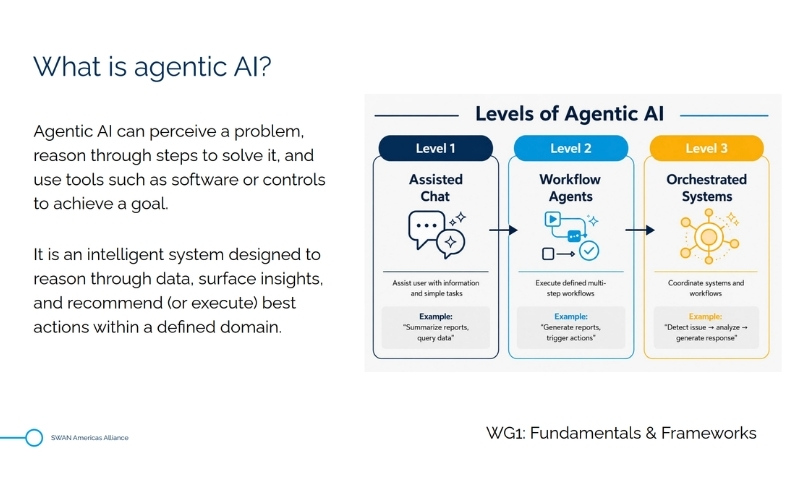
“For example, there are non-sensitive agents that clean up metadata work, flag anomalies, and reconcile GIS records against field observations, etc. The SWAN Americas Alliance is leading the development of an Agentic AI Research Project focused on curating a practical guidebook for the smart water sector that uncovers some of the different use cases already being implemented by (or at) utilities, across differing Agentic AI levels. These range from assisted chat support to executing on workflows, to more orchestrated systems, as depicted below from the collaborative mid-project progress report:
“I am curious how this space will continue to evolve from an innovation, ethical and security perspective, and ultimately in terms of accountability and performance. Will AI-enabled technology and collaborative, human and organisational workflows and decision-making mature together?”
Share your water technology stories with us
Do you have an innovation, research results or an other interesting topic you would like to share with the international water technology industry? The Aquatech website and social media channels are a great platform to showcase your stories!
Please contact our Sr Brand Marketing Manager Annelie Koomen.
Are you an Aquatech exhibitor?
Make sure you add your latest press releases to your Company Profile in the Exhibitor Portal for free exposure.