Ultrasonic shaker helps to generate water faster
Pulling water from the air as a free resource has obvious appeal, especially in countries or regions where clean potable water is scarce. Entrepreneurs and investors have been driving the technology and scope of applications forward in recent years, with Atmospheric Water Generation (AWG) garnering increased attention from non-industry press, even being featured as one of Time magazine’s top inventions of 2025.
But, even with advances in technology, AWG remains divisive among water industry experts. Does it require too much energy? Will the yields ever be worth it? Does it take too long to generate enough water to make the technology viable?
Now, researchers at the Minnesota Institute of Technology have developed a novel technique that uses vibrations to shake water out of a sorbent in just minutes, substantially speeding up the process of harvesting water from AWG units.
Big investment but still concerns
Back in 2020, Aquatech Online reported on the €43.4 million investment in Zero Mass Water (ZMW). It garnered attention because it was significantly higher than any previous investment in an AWG company. It was backed by high-profile investment funds, and investors, including Jeff Bezos, Bill Gates, Richard Branson and Michael Bloomberg.
At the time, however, the cost of using the system to produce one person’s daily water needs was estimated to be close to €1,500. Clearly, this was not a cost-effective method of sourcing water. However, even back in 2020, it was hard to see so many tech-literate backers investing without seeing potential for a decent return.
A growing, but still untapped market?
You can see the appeal. While traditional water treatment or desalination technologies require huge energy demands and large areas of land, AWG can be portable, point-of-use, and can even run on solar power.
US Geological Analysis suggests that the atmosphere contains six times as much water as all the rivers in the world. It is, potentially, a vast untapped source of water. Atmoswater Research has suggested that everyone on earth could use 50 litres of AWG-water every day and only consume 0.002 per cent of the total available.
In 2020, BlueTech Research estimated the AWG market was worth between €1.7 million and €2.7 million a year. In 2025, it is estimated that the current market is worth between €130 million and €217 million, with the potential to reach €695 million.

Making Time magazine’s best inventions list
One of the major benefits of AWG is that units are portable and can be run from either mains supply or from renewable sources. This makes the technology perfect for use in areas where a reliable and clean water source is not readily available, such as remote areas or during natural disasters.
One company, Genesis Systems, was recognised by Time magazine for its WaterCube technology, naming it one of the best inventions of 2025. Its transportable WC-1000 machine, which can produce around 1,000 gallons of potable water per day, was employed following Hurricane Milton in 2024, as a backup water supply at the children’s hospital in St. Petersburg, Florida, helping to keep its neonatal intensive care unit running. WaterCube’s are now being tested by the US military for use in field operations.
How does AWG work?
Talking to Aquatech Online in 2024, Dr Muhammad Wakil Shahzad, associate professor and head of subject, Northumbria University, UK, explained how AWG works:
“The process involves capturing humid air and cooling it below its dew point to condense the moisture into liquid form. This condensed water is then collected, filtered, and purified to make it safe for drinking.”
Shahzad explained that AWG systems typically employ two main techniques:
- Condensation-based AWG: This method cools air down to its dew point using refrigeration or other cooling technologies, causing the moisture to condense into liquid water.
- Sorbent-based AWG: This approach uses materials that absorb water vapour from the air (desiccants) and release the moisture when heated, allowing for water collection.
One of the main drawbacks of AWG is the time it takes for the water to condense into liquid water, especially in the volumes needed to make it usable.
Shaking out the water with ultrasonics
Now, researchers at the Minnesota Institute of Technology (MIT) in the US have developed a technology that can literally shake the water out of any absorbent material to speed up the process of harvesting water from the air.
Currently, the process of producing water can take hours, sometimes even days. Instead of relying on the sun to heat the absorbent, which evaporates the water out, the researchers have demonstrated that ultrasonic waves can be used to shake the water out.
At its current stage of development, the researchers place sorbent material on a device which vibrates and emits ultrasonic waves that are tuned to the frequency needed to shake out the water.
Currently requiring a power source, the researchers believe the next stage of development will make use of a solar cell that will not only power the vibration device, but could also be used as a sensor to detect when the sorbent is full and needs to be shaken to release its water; a process that could be repeated in cycles over the course of a day.
Sorbents need encouragement to part with water
Announcing the research, Svetlana Boriskina, principal research scientist in MIT’s Department of Mechanical Engineering, told media: “People have been looking for ways to harvest water from the atmosphere, which could be a big source of water, particularly for desert regions and places where there is not even saltwater to desalinate. Now we have a way to recover water quickly and efficiently.”
he explained why AWG required a new method of extracting water: “Any material that’s very good at capturing water doesn’t want to part with that water. So you need to put a lot of energy and precious hours into pulling water out of the material.”
According to the researchers, the ultrasonic design is 45 times more efficient at extracting water from the same material, when compared to using heat from the sun.
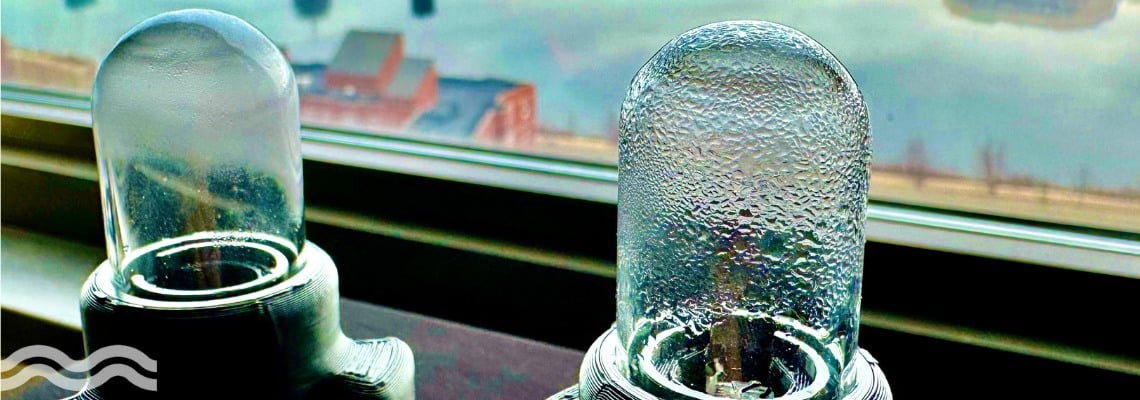
Ultrasonic frequencies, travelling at around 20,000 cycles per second, vibrate at exactly the right frequency to break the bond between the water water molecules and the sorbent materials.
MIT graduate student, and one of the researchers, Ikra Iftekhar Shuvo, said: “It’s like the water is dancing with the waves, and this targeted disturbance creates momentum that releases the water molecules, and we can see them shake out in droplets.”