Flooding: Prevention is always better than the cure, but are we prepared?
There is no doubt about the devastation caused by flooding. With climate change only heading in one direction, there is an increased risk of both local flooding and the flash floods that have swept parts of Europe in recent years. Why is climate change having such a big impact? As the world warms, the air gets moister; the World Meteorological Organization (WMO) explains it like this:
“For each 1°C of warming, saturated air contains seven per cent more water vapour on average. Every additional fraction of warming, therefore, increases the atmospheric moisture content, which in turn increases the risk of extreme precipitation events.”
The cost of flooding to Europe
According to data from the European Commission, flooding cost Europe €170 billion between 1980 and 2022. Wherever you look, the figures are stark:
- Around 12 per cent of Europe’s population live in areas potentially prone to river flooding.
- 5,582 people have died due to floods between 1980 and 2022.
- If no action is taken, coastal flooding could cost Europe €1.6 trillion by 2100.
So, what action is Europe taking on flood management and prevention? The EU has chosen to adopt its Water Resilience Strategy, which is a long-term plan to ensure effective water management takes place across all member states. Part of the strategy is to ensure existing directives are enforced and are working efficiently. Two of these are aligned in seeking to prevent flooding risks: the Flood Management Directive and the Nature Restoration Regulation.
Europe’s Flood Management Directive
This requires Member States to assess whether water courses and coastlines are at risk from flooding. To do so, states must map the flood extent, and assets and humans at risk in these areas, and take adequate and coordinated measures to reduce this flood risk.
Devastating floods in Spain
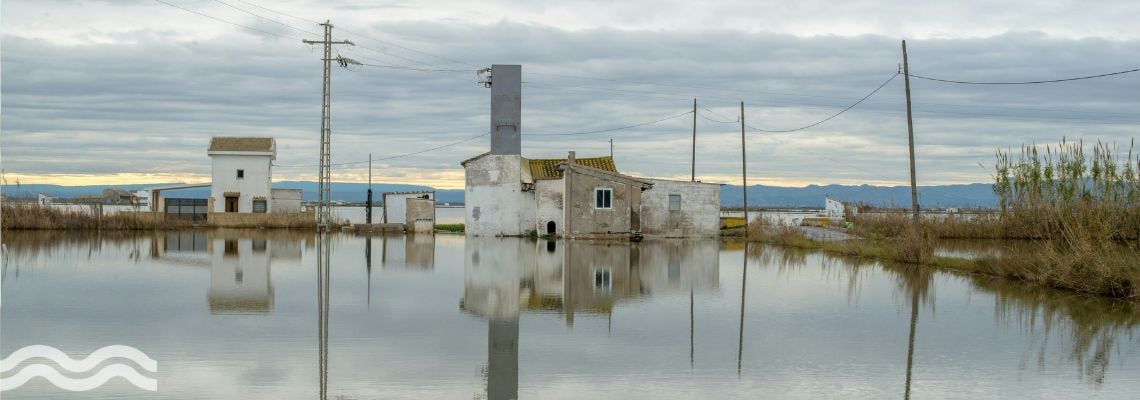
Flooding has devastated parts of Europe over the past year, with Spain experiencing record levels. According to the WMO, the Valencia region was the worst-hit area, with one weather station recording 491 l/m² of rain in eight hours: the equivalent of a year's rainfall.
This extraordinary rainfall event had awful consequences as torrents of water swept people and their possessions away; transport links were disrupted, and tens of thousands of homes and businesses were left without power. More than 200 people lost their lives in this one event, with the Spanish government declaring three days of national mourning.
During the height of the tourist season, more than 50 provinces in Spain were affected by flooding, with the impact on people’s lives felt across the economy as key areas, such as tourism and agriculture, suffered both immediate and mid to long-term effects.
Flooding in the UK
In the UK alone, the cost of annual flooding is calculated in the billions. Nearly two million people are exposed to flooding, with a third of the UK’s critical infrastructure at risk. This includes energy networks and water systems, as well as public transport links.
Current government spending on flood defences stands at €1.48 million, with the National Infrastructure Commission recommending this increase to €1.7 million. Interviewed in the Guardian newspaper, the lead author of that study, Emma Howard Boyd, a visiting professor at the Grantham Research Institute and former chair of the UK’s Environment Agency, suggested every investment in flood defences is a return on investment, with every £1 spent preventing £8 of damage.
A report by Public First suggests that we should assess the impact of flooding not only by the immediate damage caused and the clean-up costs, but also by the effect it has on the economy in subsequent years; a knock-on effect.
What can be done to prevent flooding?
Prevention, as they say, is better than the cure. And is certainly better than dealing with the huge costs, both human and financial, caused by flooding events.
Mapping and predicting flood risks is increasingly becoming an area where AI tools, such as digital twins, are coming into their own.
In Spain, Amazon Web Services (AWS) is investing €17.2 million across three projects in Zaragoza, where it operates a number of data centres. The projects will help to reduce the flood risk to more than 700,000 residents, modernise critical infrastructure, and optimise agricultural water use through artificial intelligence (AI).
Northern-Ireland-based StormHarvester received €10 million in investment at the beginning of 2025, to help scale its software-as-a-service (SaaS) offering that uses machine learning and rainfall prediction to help wastewater utilities prevent and tackle flooding and pollution events.
Flood Intelligence software receives Series A funding
UK-based Previsico is the latest technology company to receive significant Series A funding. Its flood alert and forecasting platform combines three core services: flood forecasting, with up to 48 hours' warning driven by live hydrodynamic modelling; hydrological monitoring; and flood risk insights, which makes use of existing sensor data and bespoke models.
Users of the platform can view live, interactive maps and a real-time risk assessment, helping them to prepare for the likelihood of flooding events, and therefore, helping to mitigate risks.
Currently used mainly by insurers, the Series A funding will allow the company to expand its reach directly to insured parties, such as major construction firms, infrastructure operators, and other large asset owners.
Previsico’s CEO, Jonathan Jackson, told Aquatech Online: “The investment will enable us to scale into new markets while strengthening our ability to deliver surface water flood forecasting insights and live monitoring solutions.”
He added: “We are about to roll out a major platform upgrade, Flood Intelligence 2.0, with new features, such as probabilistic forecasting.”
Viewpoint: From adaptive water management to urban water resilience

Innovative stormwater management and reuse

Water, innovation, and sustainability: A strategic vision for Mexico’s future
Funding fuels on-site pathogen detection expansion