Desalination continues to dominate security strategies

The continuing case for more desalination
As populations grow and the demand for fresh, clean water increases, the gap between what we can supply and what will be needed continues to grow wider. It has been estimated that urban water demand alone will increase by 80 per cent by 2050.
With demand also likely to rise from both agriculture and industry, water security in every part of the world will come under greater scrutiny. While desalination alone will not solve every water challenge, it forms the backbone of many countries' water strategies, especially in areas that receive little rainfall and where groundwater reserves are under pressure.
Water is both a human need and an economic driver: from sanitation to drinking water, to data centres and industrial complexes. Desalination has played a big role in Spain’s resilience against long-term drought. According to IDRA, the European country has a daily capacity of 5 million m³, produced by 765 plants, including the continent’s largest in Torrevieja, which has plans to expand its production to 120 hm³/year. During the droughts of 2024, Barcelona increased its desalination by 33 per cent to keep the city running. Spain’s government has plans to double its installed capacity (including reuse) by 2027, with €23 billion of funding committed. Plans also include the greater use of renewable energy to offset energy costs.
Europe is getting drier, and its aquifers are being depleted. As such, even areas that are traditionally seen as ‘wet’, such as Cornwall in southwest England, have explored the need for desalination capacity to help future-proof the area from the effects of changing weather patterns and drought.
Energy efficiency is becoming increasingly important
Energy efficiency becomes increasingly important in the desalination world. As above, the Spanish government is determined to increase the percentage of renewables in the total energy used for desalination, which is a guzzler of electricity.
The Guinness Book of World Records might not be the first place you would look for innovative energy-efficient desalination projects, but it contains an entry for the DESALRO 2.0 project based in the Canary Islands, which achieved the lowest energy consumption for a seawater desalination plant – 1.794 kWh/m3 – on 26 February 2025.
And while members of the Canary Islands Institute of Technology (ITC - DESALRO 2.0) had to wait until the end of the year to receive their certificate, the plant continues to achieve energy consumption of less than 1.9 kWh/m. The plant operates from two containers under real-world conditions, and among the technological solutions, it uses pumps from Danfoss and both pumps and a pressure exchanger from Energy Recovery in its solution. This scalable solution offers low-cost desalination at energy consumption rates that are 20-25 per cent lower than conventional designs.
Energy efficiency is also high on the agenda in Oman; the Barka V Desalination Plant, which is operated by GS Inima, will integrate a solar photovoltaic facility to reduce its dependency on gas-fired electricity. Currently operating with a production capacity of 100,000 m³ per day, it is expected that the 6.3 MW solar PV facility, which is being built next to the plant, will supply approximately 11 per cent of its energy needs.
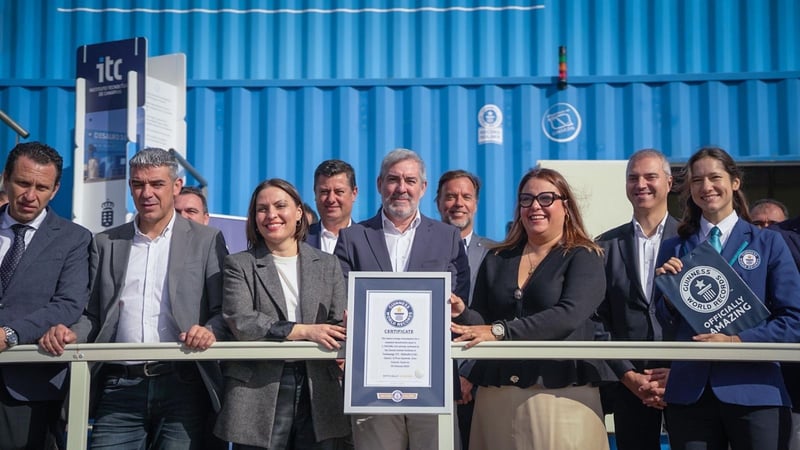
Credit: Technological Institute of the Canary Islands
2025, the year of desalination
Across the Aquatech news site, 2025 featured several desalination stories, including:
- 20,000 leagues under the sea: Why the latest desalination investments are looking to the bottom of the ocean
- Agadir upgrade increases desalination capacity as Morocco grapples with scarcity
- Latest desalination innovation in China
- Is water and power integration the future of desalination in Kuwait?
- Texas kickstarts new desalination frontier
- Senegal turns to desalination to address water scarcity concerns
Collaboration across borders is driving desalination
If the last few years have proved anything, it is that building and operating desalination plants is a cross-border collaborative process. For example, Saudi Arabia’s ACWA Power has signed an energy and water cooperation deal with the African Development Bank; the multi-million dollar deal will cement a partnership that will oversee the development, investment and financing of power generation and water desalination projects across the African continent.
Elsewhere, the European Bank for Reconstruction and Development (EBRD) is providing a €6.3 million loan to Egypt-based Ridgewood for Water Desalination to finance the construction of new desalination plants along the country’s Red Sea and Mediterranean coasts. The finance will also support the upgrade of existing facilities.
Egypt faces an annual shortfall of around 7 billion m3, with the Nile River accounting for 97 per cent of its freshwater resources. The new small-scale desalination plants will help to improve the country’s water security.
In Algeria, three new desalination plants, each with a capacity of 300,000 m3/day, are being constructed following the signing of an agreement overseen by energy utility SONATRACH. The three plants will form the first phase of a project that will see a further three being built in response to the growing demand for drinking water. The country has committed to increasing its desalinated seawater production to 5.6 million m3/day by 2030.